I suppose most of us, in our own minds, think we lead pretty unexciting lives. Barak Obama, in his secret life, wishes he were an NBA star—hell, even James Bond probably fantasizes life as a NASCAR driver. I’m no different, except no one I know has ever been called in to an FBI interrogation.
It was in the carefree spring of 1973. You remember; peace, love, equal rights for vegetables. A newly minted college graduate, I was in grad school, part-time at night, and working construction to make ends meet. Not only was I the only college graduate on the laborer crew, I was the only one without a prison record. Lunch conversations were embarrassing—one fellow had done five years for grand-theft auto, another had shot a man five times in a bar fight. Me? I got a ticket once for passing a school bus. I tried to fit in; smoked Camels, the pack rolled up in the sleeve of my t-shirt, shot craps behind the foreman’s trailer on Fridays after work. I even used the “f word” as an all-purpose modifier in my speech. Nothing seemed to work; I would always be the college kid, the misfit, the nerd.
One Tuesday evening after class, my friend Freddy talked me into attending the circus. No, not the Ringling Brothers variety, a small, one ring, European, family circus was touring colleges around the East Coast. They were performing one night only on campus and admission was free. I said OK and we went. Acrobats, aerialists, a trained bear, great fun. I noticed that all the performers with the possible exception of the bear, all seemed related—family circus indeed.
I was giving Freddy a ride back to his place when my car was nearly blown off the road by a passing fire engine headed someplace in a big hurry. “Cool!” Freddy said, “Let’s see where they’re going.” Sure, I thought, why not. I followed the truck to the parking lot of the campus armory, where it joined other pieces of equipment already there. The firemen, all volunteers, and all woefully undertrained, leapt from the engine, and began running around, tripping over hoses running into each other, and acting like act II, the comedy part, of the circus we had just left. The only thing missing from the whole fiasco was the fire. No flames, no smoke, not brave firemen rescuing fainting maidens from upper story windows. “Huh,” Freddy shrugged, “I thought it would be better than this. Let’s go.”
Next day, I was digging a hole when the foreman emerged from his trailer. “Al,” he shouted, “call your mother.” My stomach turned, nobody ever got a message from the foreman to call home unless it was something dire. Did my dad have a heart attack? Brother in a car wreck? Heart pounding, I made the call from a pay phone. “The FBI called” my mom said, “I didn’t tell them anything.” My mom was a war bride, having grown up in Nazi occupied Europe. When the authorities came calling, you didn’t say anything. She gave me the number and I made the call.
“Agent Van Dorn speaking.” Came the reply. I identified myself and asked what was the problem. “The armory at the University was firebombed last night and someone saw your car leaving the scene. We would like to talk with you.” “Okay…” I said, “I can take off from work and meet you at your office.” “No no,” Agent Van Dorn replied, “I don’t want to make you miss too much time. Let’s meet off Route 29; there’s a parking lot by the Giant.” This was beginning to sound like a bad cop show. I had visions of large, heavily armed men in flack jackets with instructions to take no prisoners surrounding my car. “It’s ok,” I said, “I can come to your office to discuss this. No problem.” I got the directions from a disappointed sounding Agent Van Dorn and told the foreman I was going to an FBI interrogation.
A half-hour later, I was walking into the FBI field office in Silver Spring. I was dirty, my jeans and work boots encrusted in mud, and leaving muddy footprints on the polished tile floor. I was escorted to an interrogation room and left to wait. I began to wonder just what I had gotten myself into. One wall was covered by a large mirror, doubtless two-way, and a photo of the J. Edgar Hoover Marksmanship Trophy, presented to Agent Van Dorn, adorned the other wall. Two large men came in. Agent Van Dorn, almost certainly, along with another agent. Both men were in dark suits, dark ties, and pocket handkerchiefs. Standard FBI garb. Agent Van Dorn read me my Miranda rights and repeated what he had told me over the phone. He asked what I had been doing at the scene of the crime. I told him all about the circus and the fire engine. I ended by saying “It was like when you’re a kid, and a fire engine goes by—you just want to see where it’s going.” Agent Van Dorn smiled and nodded. “Yeah,” he said, “you don’t have to be a kid to enjoy a good fire.” A phrase that would resonate in my head for probably the rest of my life. He thanked me for my time, took the names of corroborating witnesses, and told me if anything further came up, he would contact me. I was free to go.
When I arrived at the job site the next day, Jack, the biggest baddest dude on the laborer crew came up to me and said “I hear you were questioned by the FBI.” Apparently the foreman had passed the word. “Yeah,” I said, “No big deal.” I noticed the other guys on the crew began to talk to me more, joking and offering smokes. It dawned on me…I finally fit in; I had street cred.
Saturday, February 27, 2010

Saturday, February 20, 2010
The Departed
The thing about ghost stories is that, although each has a central core, something that always stays the same, details differ with whoever is telling it. And ghost stories should be told. They are part of a human tradition as old as language itself. When such a story is locked in print, something is lost—the printed version becomes the baseline, the unimpeachable source against which all facts are measured.
Take the case of Alexandria’s Female Stranger. The truth, as far as anyone can reasonably determine, is that in September 1816, a ship, bound from the West Indies, docked at the Alexandria wharves. A young couple disembarked, the woman very ill, probably with typhoid or yellow fever. They took a room at Gadsby’s Tavern. A physician was called as well as a pair of nurses. The husband requested the doctor and nurses, as well as the inn-keeper’s wife, swear an oath never to reveal the couple’s name. Tragically, the young woman, declining all the while, died in her husband’s arms in October. She was (some say, secretly) buried in St. Paul’s Cemetery under a headstone with the name “Female Stranger”. The young man disappeared and the doctor and nurses kept their vows, never revealing the names. End of the facts as written—the mystery now becomes legend.
Depending on who is telling or writing the story, things take off from there. Speculation on the couple’s identity ranges from the daughter of Aaron Burr, to the disgraceful outcome of a love triangle ending in a fatal duel and furtive flight. Some stories have the young man dying in prison while others have him moving up the Potomac and becoming a recluse, overcome by grief, and living in a lonely ramshackle cabin by the river’ edge. He journeyed regularly down river to Alexandria to visit his beloved’s grave. Since nothing was known about him, locals took to calling him “John of the Cabin” or simply “Cabin John”. The name lingers today in a small community on the Maryland side of the river.
Another version of the story, told in Gadsby’s Tavern, concerns a beautiful young woman, who, dressed in the style of the early 19th century, frequented formal dances held in the ballroom on the second floor. The ballroom was down the hall from the room taken by the unknown couple years earlier. She never spoke or danced with any would-be suitors, and always slipped away before the festivities ended. One evening during the Civil War, a smitten young Union officer followed her as she left the ball, hoping to strike up a conversation with this mysterious beauty. Upon entering the room down the hall, he found it empty, with a lamp lit in the corner. He notified the manager of an unattended flame and the two went back to the room. When they got there, the room was dark and the candle wick in the lamp was unblackened—it had never been lit. As the puzzled young officer was leaving the room, he touched the glass globe of the unlit lamp. And burned his fingers.
As a student of the paranormal once said: If you believe, no explanation is necessary; if you don’t, no explanation is possible.
Saturday, February 13, 2010
Interglacial
It’s official, we’re number one—the D.C. area has broken the record for snowfall set in the winter of 1899. Hooray. We topped the charts at 55.6 inches of the stuff. This may seem trivial to someone from oh, say, Buffalo where they probably get this much in August, but then we don’t have the experience or the equipment to deal with a snowpocalypse of these proportions. Drinks on the house. Little kids, when they are old and creaky, will tell their grandchildren “I remember back during the winter of aught 10. You couldn’t see above the snow and we had to walk to school in the blizzard. Up hill. Both ways. And the snow was flying, the wind was blowing, the wolves were howling and the volcano was erupting to boot.” Sure grandma. Maybe some future president has noted the ungodly amounts of snow in his or her journal just like Washington and Jefferson did back in the terrible winter of 1722.
Here in Northern Virginia, we get ready for a big snow by emptying the stores. Bread, milk, and toilet paper are the first to go. My daughter and I thought we would be clever and went to the supermarket two days before the onslaught of the first big storm back in early February. Ha! Shelves were already empty and we waited to check out for an hour and a half. The line actually did move, people were friendly, and we spent the time playing word games involving the contents of our cart.
Come the snow, and I was getting cabin fever at inch two. I took walks with the dog, spent time on line, worked on projects as the snow began piling deeper throughout the weekend. When it was over and the familiar sound of shovels on pavement began to ring through the neighborhood, I went out and cleared the sidewalk and driveway. Not too bad a job, thank god for ibuprofen. When the next set hit, it was more of the same, except this time it took longer and longer to make any headway. It wasn’t so much shoveling as it was trenching—I felt like a World War I doughboy. My neighborhood now looks like trench warfare has broken out.

Cars in their driveways sit in snow revetments, waiting on the barrage.

Uncleared cars are humps in the snow covered landscape, looking for all the world like igloos with sideview mirrors. Snow plows leave several feet of snow in their wake, which needs to be moved before it turns to ice.

I dig down to the lower layers of where I think the sidewalk went and flashes of blue spark and glimmer. This is the color of glacier ice. It is also an early symptom of snow blindness where enough UV hits your retinas to cause sunburn. The worst part is when the retinas peel just like the skin on your arms at the beach. I’m told it feels like sand in your eyes. Antarctic explorers don’t wear sunglasses to look cool.
My bird feeders, filled just before the blizzard, are doing a land office business. The smaller birds have been supplanted by the big boys—starlings, blue jays, and the occasional woodpecker, all feeding on sunflower seed and suet. The little guys have to make do.


Snow is patient—this is how ice ages start. Pile it up high enough and it will last through the summer, to form a base for the next winter’s offerings. Keep it up long enough and the bottom layers compress to ice. Or you could just run a car over it a few times. Some of this stuff will still be here in June, remembering the glory days of the Pleistocene, which in geological terms, was only a few hours ago. Keep in mind—even with all the fuss about global warming, we are in what geologist call an “interglacial period”—the ice will be back. I think my driveway will be the tipping point causing the next advance of ice.

Friday, January 29, 2010
Payback
Sometime during the night a deer died in the marsh. By morning, only the rib cage remained above the surface in the shallows. A flock of crows were sitting in attendance and picking scraps from the bones, somber black feathers appropriate to the wake.

If you had to pick an all-purpose bird, it would be a crow. Feeding on anything more or less biodegradable, the American crow lives anywhere from the edges of the high Arctic to the edge of the South American rainforest. Social birds, crows form huge winter roosts which act much the same as singles’ bars where unattached birds pair up, usually for life. The young from the previous year stay around the nest, helping the parents raise the new brood, and acting as babysitters and gaining experience. Crows flap their wings fairly slowly, seemingly rowing their way across the sky. Highly maneuverable, crows will stay just out of harm’s way when harassing large hawks, seemingly just for the sport. The hawk eventually tires of being bullied and flies off to another, quieter perch. At least until a crow finds it.
 Crows meet their match, however, in the ring-billed gull. Medium-size, for gulls, ring-bills are true masters of their medium. They can soar like vultures on their narrow wings and dive on fish and other prey like hawks, loosing airspeed by flipping over in midair, spilling wind from their wings. Gulls are consummate scavengers and thieves, living their wits and going by the motto: “You find it; I’ll help you eat it.”

Woes betide any crow that has picked a tasty morsel from the aforementioned deer carcass and attempts to fly off in hopes of a snack. Gulls are on it in a screaming, milling mob. In a few seconds, the mob reduces to one or two gulls, shadowing the crow’s every move. What follows can best be described as a mixture of aerial ballet and back-alley mugging.

The crow swoops low to the water, eliminating attack from below. The gull puts on a burst of speed, bringing it to within reach of the crow’s tail feathers which get yanked.

The crow veers left and right, with the gull mirroring every move in hot pursuit. The crow climbs to escape but the gull is better at it and follows at a closing angle. The exhausted crow finally drops the morsel the gull casually snags it out the air and leaves the scene followed in turn by a new set of pursuers.

The gull climbs steeply, does a wing-over to allow most of the flock to pass it, and drops the tidbit. The morsel, by this time just a toy, is passed in midair from gull to gull, until somebody finally eats it. You can almost hear the gull say to the poor crow, “That’s how you do it, Jack.”

The flock settles to the surface until another hapless crow launches into the air with a bit of venison in its beak. You get the feeling the gulls chase crows to distraction because they can and are having a grand old time doing it.
Monday, January 11, 2010
Winter Hawks
Winter has settled in with snow and a week’s worth of below freezing temperatures. The marsh is pretty well locked in ice. The ducks have deserted, moving to the nearby Potomac where the current keeps the water flowing. A flock of ring-billed gulls crowd the only patch of open water, a few crows and a single family of geese hovering on the ice at the edges. A lone snipe circles the marsh, looking for unfrozen mud to forage for small invertebrates
Sparrows work the fast land, gleaning seeds and bits of whatever they can find. Song and white-throated sparrows scratch at the dead leaf cover like tiny barnyard fowl while swamp sparrows, true winter residents, flit through the brown and brittle cattail stalks. A downy woodpecker works its way up a cattail, looking for telltale holes made by larval insects now chilled and sleeping in the heart of the dead brown cane.


Hawks are out today, cold weather seems to their liking. One of the resident red-shouldered pair perches on a dead limb, surveying the frozen marsh, watching for any flicker of movement that might betray a mouse or vole. Motionless as a museum specimen, it follows my movement in its direction, flying off before I get within decent camera range.

Farther in the woods, I flush an adult female red-tail hawk from the ground. She lumbers into the low branches, the furry bundle of a former squirrel clenched in a talon. She perches and finishes her lunch, feathers gleaming and copper tail tucked. Red-tails are the utility infielders of the hawk clan—big enough to take anything from mice to rabbits, and fast and agile enough to get by. They are at home everywhere from the Arctic to Tierra del Fuego. One of the things I like about red-tails is that when you are close enough to really look at them, they always look back, yellow eyes bright as gold doubloons. Prey animals don’t seem to notice you—when they know they have been seen, they glance about in all directions doubtlessly calculating escape trajectories and factoring in all the variables. Predators like red-tails tend to look you in the eye in recognition of a fellow apex predator—top of the food chain, Ma. Then they go about their business, which in this case was polishing off lunch.

The red-tail female’s crop bulges and she casually flies off, leaving the skin of her prey draped over the branch. If she were truly hungry, she would leave nothing. Her round crop and the leftovers tell me she is “fed up” and looking for a quiet place for digestion and contemplation.

Near the parking lot, yet another hawk perches on a low oak branch close to the trunk. This one is an immature Cooper’s hawk as evidenced by the red irises (adults have yellow eyes). Coopers hawks used to be fairly rare this far south but have discovered bird feeders and will hang about all winter, picking off the unwary, the slow, or the just plain unlucky. Populations have blossomed to where every neighborhood has a Coop or two in residence.

The wind gusts through the trees, branches rattle, no human sounds are in evidence. I could be walking through a forest on the edge of the tundra thousands of years ago where glaciers loom in the distance and the ancient rhythms pulse.

Wednesday, December 23, 2009
Solstice
I awoke today and found the frost perched on the town
It hovered in a frozen sky, then it gobbled summer down
When the sun turns traitor cold
And shivering trees are standing in a naked row
I get the urge for going but I never seem to go
Sharp clear days, bitter nights. Winter has made its entrance. Brown cattails in the marsh, dry stalks rattling in the breeze. Groups of geese and mallards in the lees of the islets, a pair of northern shovelers and a hooded merganser couple working the open water, sculpted ice filming over the shallows. The seasons have finally flipped to cold. The warriors of winter give a cold triumphant shout
And all that stays is dying and all that lives is getting out
See the geese in chevron flight flapping and racing on before the snow
They've got the urge for going, they've got the wings to go
It hovered in a frozen sky, then it gobbled summer down
When the sun turns traitor cold
And shivering trees are standing in a naked row
I get the urge for going but I never seem to go
Sharp clear days, bitter nights. Winter has made its entrance. Brown cattails in the marsh, dry stalks rattling in the breeze. Groups of geese and mallards in the lees of the islets, a pair of northern shovelers and a hooded merganser couple working the open water, sculpted ice filming over the shallows. The seasons have finally flipped to cold.
 The warriors of winter give a cold triumphant shout
And all that stays is dying and all that lives is getting out
See the geese in chevron flight flapping and racing on before the snow
They've got the urge for going, they've got the wings to go
 Joni Mitchels’ pean to lost love notwithstanding, winter is a time of subtlety and brief flashes. Gone is summer’s exuberance, its myriad of bright colors clamoring for attention, scraps of orange and bright reds and blues on the wings of butterflies and dragonflies, pure yellows and creams on tucked-away wildflowers. Winter, to me, is when you really get to look—when things you normally wouldn’t see demand you notice them. Blue jays, carrying bits of hot summer sky in their feathers, and cardinals, glowing like banked coals, stand out amidst the grays and browns of the landscape. Red-shouldered hawks change their hunting tactics, moving like cats from branch to branch, hoping to ambush the odd unwary mouse or small bird.
Trees, the garnish of green leaves brown and fallen, stand as living sculptures—oaks with their single column of trunk and elms, branches spreading like upside-down vases, invite inspection and dare you to ID them using only the winter clues. Shy hollys and mountain laurels peek out from the understory, their thick leathery leaves finally noticeable after a seasons worth of blending into the overall green. Berries glow red in the thin winter sunlight, advertising their calories to the birds.
In addition to the skeleton crew of over-wintering locals, migrants have come in from farther north where winter really is a thing of privation and scarcity. Brown creepers, little whiffs of birds fresh from the North Woods, spiral up the trunks of winter-bare trees, gleaning their way up in search of insect eggs and chilled larvae. Nuthatches spiral their ways down those same trunks, finding tidbits over-looked by the upward climbing creepers. Eiders and harlequin ducks, fresh from Greenland and Baffin Island, bob in coastal inlets, while tundra swans have made their long flight from the high arctic to sport in the Potomac and its creeks. For most of these birds, this is about as far south as they get and must seem like a tropical vacation.
A foot and a half of snow changes the equation for everyone. For me it means digging out vehicles and clearing sidewalks and trying to ignore a tiny voice in the back of my head that says “Y’know, your uncle had a heart attack and died while shoveling snow. And you're older than he was.” I pace myself, conscious of my hammering pulse, thankful for a strapping 20-year old son to do the heavy lifting.
Overwintering sparrows work the snow-free ground at the undersides of branches and in thickets, scraping the leaves for tidbits like miniature chickens. Our four species of woodpeckers diligently work the snow-splashed tree trunks. I usually wait to put out my sunflower seed until the first of the year but am seriously rethinking. On the other hand, these are full-time wildlife, adapted to the landscape over the course of millions of years and I am just a part-time bird feeder. I defer to their judgment.
I'll ply the fire with kindling and pull the blankets to my chin
And I'll lock the vagrant winter out and bolt my wandering in
I'd like to call back summertime and have her stay jut another month or so
She's got the urge for going and I guess she'll have to go
And she gets the urge for going when the meadow grass is turning brown
All her empires are falling down
Winter's closing in.
Saturday, November 21, 2009
Fall Snapshots
Autumn is meandering along on its way to winter. A few vestiges of summer abide—the chilled tattered late dragonfly and lost-looking turtles. Early winter residents like slate-colored juncos and white-throated sparrows are showing up. Both are sometimes fooled by autumn days—day length is about the same as mid-May, and you can hear the occasional spring peeper call in the swamp. The odd white-throated sparrow as well begins to tune up its song, which sounds like “old Sam Peabody, Peabody, Peabody”, but they rarely get past the “Sam” part—maybe they figure out what is going on and are too embarrassed to continue.
If you keep your eyes open, you can see some of the fall specialties in evidence. A four-point buck, neck swollen from testosterone, picks his way across my backyard, oblivious to everything and everyone but does. (This is the time of year you see road-killed deer whenever you run an errand). Squirrels, their autumn breeding season in full swing, scamper up tree trunks in twos and threes and fours, spiraling their way like long gray scarves. Oak trees are finally releasing their crispy brown leaves to pile up in the gutters. Oaks are the last to let go in fall—I’ve heard Garrison Keeler explain it as vanity, but since they are among the last to leaf out in spring, it all evens out.
A northern harrier (aka marsh hawk) moseys his way across the marsh at Huntley Meadows. Banking and turning at walking speed, he checks out the flocks of mallards, testing for any sign of weakness as they explode off the surface. The harrier, rump showing the bright white diamond of feathers that screams “field mark!” to any birder, milks every erg of energy from the breeze with an ease and efficiency any America’s Cup skipper would sell his soul for. And the harrier does it in three dimensions to boot. He will linger here for a few days before moving on for the winter to the more expansive Potomac River marshes, sharing the area with the night shift of short-eared owls.
Canada geese, too big for the harrier to bother with, are busy harvesting a summer’s worth of marsh sedges. Think of them as feathered sheep, grazing on the swamp grasses, pulling up the stalks to feed on the calorie-rich rootstocks. Bow waves of grass blades form as they swim through the shallow water, past the skulking Virginia rails who have taken up residence in the marsh and pad daintily between the faded brown stalks of cat-tails, long since gone to seed. A pair of hooded mergansers newly arrived from points north, skirts the edges of the marsh, jumpy as cats, while northern shovelers doze in the watery sunlight.
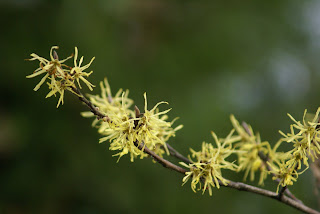
Here and there, almost like after thoughts, or maybe grace notes, American witch hazel is in full bloom, forsythia-yellow blossoms the same color as maple leaves and easily overlooked amid all the riot of color.
The planet is turning, winter closing in, but not just yet. There is still business to be done, still things to do before the cold falls and the hemisphere sleeps.
If you keep your eyes open, you can see some of the fall specialties in evidence. A four-point buck, neck swollen from testosterone, picks his way across my backyard, oblivious to everything and everyone but does. (This is the time of year you see road-killed deer whenever you run an errand). Squirrels, their autumn breeding season in full swing, scamper up tree trunks in twos and threes and fours, spiraling their way like long gray scarves. Oak trees are finally releasing their crispy brown leaves to pile up in the gutters. Oaks are the last to let go in fall—I’ve heard Garrison Keeler explain it as vanity, but since they are among the last to leaf out in spring, it all evens out.
A northern harrier (aka marsh hawk) moseys his way across the marsh at Huntley Meadows. Banking and turning at walking speed, he checks out the flocks of mallards, testing for any sign of weakness as they explode off the surface. The harrier, rump showing the bright white diamond of feathers that screams “field mark!” to any birder, milks every erg of energy from the breeze with an ease and efficiency any America’s Cup skipper would sell his soul for. And the harrier does it in three dimensions to boot. He will linger here for a few days before moving on for the winter to the more expansive Potomac River marshes, sharing the area with the night shift of short-eared owls.
Canada geese, too big for the harrier to bother with, are busy harvesting a summer’s worth of marsh sedges. Think of them as feathered sheep, grazing on the swamp grasses, pulling up the stalks to feed on the calorie-rich rootstocks. Bow waves of grass blades form as they swim through the shallow water, past the skulking Virginia rails who have taken up residence in the marsh and pad daintily between the faded brown stalks of cat-tails, long since gone to seed. A pair of hooded mergansers newly arrived from points north, skirts the edges of the marsh, jumpy as cats, while northern shovelers doze in the watery sunlight.
Here and there, almost like after thoughts, or maybe grace notes, American witch hazel is in full bloom, forsythia-yellow blossoms the same color as maple leaves and easily overlooked amid all the riot of color.

The planet is turning, winter closing in, but not just yet. There is still business to be done, still things to do before the cold falls and the hemisphere sleeps.
Subscribe to:
Posts (Atom)