Sunday, June 16, 2013

Darwin unchained


Galapagos 

Darwin

Alec and I went a  Smithsonian lecture on the Galapagos  Archepelego. Everything from the structure of the Cocos Hotspot and the giant subsurface magma plume which formed the islands to the very strange fauna and flora which live there. And, of course, the man who forever will be linked to this dubious earthly paradise, Charles Darwin. Turns out, that Darwin and the HMS Beagle only spent four weeks out a total four-year cruise. They only visited four of the over twenty islands in the group. Four islands in four weeks; sounds like a budget vacation.
While visiting, Darwin made note of the several species of mockingbird, but pretty much neglected the (Darwin's finches) which he only began to puzzle over when he got home and the British Museum specialist told him that they were all, indeed, finches.  Chuck could be somewhat obtuse like that, even after the deputy governor told him that the giant tortoises were identifiable from their shell shape to specific islands. He mulled things over for close to 20 years until a letter to a mutual friend from a largely self-educated biologist working in the East Indies came to his attention. This fellow, one Alfred Wallace, came up with the same idea of change through natural selection. Darwin panicked and the mutual friend suggested they coauthor a paper to the Royal Society. The paper on natural selection was presented to not much enthusiasm. Truth be told, Charles Darwin was always something of a slapdash biologist. 
He trained as a physician at Edinburg but got nauseated by the sight of blood. Then took a "gentleman's C" at Cambridge in theology. He signed on as super cargo aboard the Beagle and spent the next five years cruising around the world.
The story goes that as a young man, he was collecting insects when he pried up a chunk of bark to find two species of beetle new to his collection. He grabbed one in each hand when he saw a third crawling away. Loath to loose it, he popped one into his mouth. Bad move, the erstwhile tasty morsel turned out to be a bombardier beetle which released a stream of boiling hot acid into his mouth. Despite everything, he kept all three for his collection. Thus are great naturalists born.

The professor and the pocket knife

The story on Facebook by a friend of Ariel, regarding a class running from 5 to 8 PM reminded me of a similar experience. My class was at the same time, 3 days a week. Fortunately, the professor set up a schedule for each of us to bring a snack for the class.  He would supply coffee.  After some initial hesitation, things began to run like clock work as veggie platters and dip, brownies, or a couple of dozen donuts made welcome appearances and were eagerly devoured by starving grad students.

 One memorable occasion, the treat was from the professor's wife in the form of a large Texas sheet cake.  She even supplied a stack of paper plates, napkins, and a box of plastic forks. Alas, she neglected a knife with which to slice the delicacy, which must have weighed several pounds, and was redolent with chocolate.  "Anybody got a knife?" the professor asked.

Immediately every one of us brandished their Swiss army knife. It looked like a scene  from "West Side Story" as played by gangs of biologists. The professor considered the array of cutlery before him and replied "Naw, y'all been cutting weird stuff with those." 


He took out his own pocket knife, a veteran of many a field dissection and geological sampling, and sliced the cake. To his credit, he did sterilize the blade by passing it through a Bic lighter flame. The cake was delicious

Thursday, February 9, 2012

Homage to Henry Pratt

It was a combination of a bad pun inspired by 1930’s classic horror movies, and modern supermarket technology. Ariel and I were at the Safeway, grocery shopping. She had scampered off to another section to retrieve something overlooked on our list.

I was in the produce department choosing veggies. The list said "Limes, (2)" . I picked my way through a pile of the green orbs, finding two that were heavy for their size (the way you choose citrus). Inspiration struck. I held the two limes over my head and cackled “it’s a lime! It’s a lime!” in my best Dr. Frankenstein voice, ala Colin Clive in the 1929 classic film. Just as I finished my intonation, the auto mist in the fresh vegetable aisle went off, complete with canned rainforest thunder. The peal faded, I double over in self inflicted laughter, and Ariel came round the corner, witnessing the whole thing. “Daddy, you are so weird.” Was her comment, but she was laughing as she said it.

Thursday, December 15, 2011

Christmas, 2011

Earth’s odometer is set for another click. This has been a year of gains and losses, endings and beginnings. We hope your year has, on the balance, been one of joy and wonder.

In February, Pat and I decided cabin fever was taking hold, so we boarded a train and rode all night to Charleston, South Carolina for a 5-day mini vacation. Charleston is called the “City of Churches”, and they aren’t kidding. Dozens of them; in every denomination you care to name, including Huguenot (French Protestant), all with intricate wrought iron work at the gate.

We devoured Low Country cuisine such as gumbo, shrimp and grits, fried oysters, and more shrimp—my stomach was rising and falling with the tides. We visited the Charleston Aquarium and I took a boat ride into the harbor to see Ft. Sumter, where the Civil War began (astonishingly enough, no one was killed during the bombardment) and the original flag is on display.
We visited an antebellum rice plantation, now a nature preserve, complete with alligators and ibis. We took a walking tour of Charleston’s pirate history and our guide regaled us with stories of Blackbeard, Stede Bonnet, and of Calico Jack Rackham and his cross-dressing pirate crew.


Rhiannon, our niece, was wed this August in Indianapolis, and we were invited.

Ariel flew, and Pat, Alec, and I drove. The only catch was, it was a held at GenCom (the Sci-Fi and fantasy gamer convention; both Rhiannon and Eel, her betrothed, are avid gamers); so a fantasy/time travel theme was suggested, costumes and all. Everyone at the convention, wedding guests included, appeared in various garb, fanciful and otherwise. Dr. Who in his many incarnations and dozens of Starwars characters (my favorites was the Imperial Storm Trooper in a kilt) tended to predominate; at least among the ones I recognized. Ariel was a 1940’s pinup girl, Alec, a Walk-Like-An-Egyptian pharaoh. Pat went as Lady Sybil Vimes, a character from Terry Pratchett’s Disk World series. Lady Sybil is an aristocratic (read: Old Money) lady, the last of her line who spends her time doing Good Works; she runs a charity for homeless dragons. Al went as a pirate; with his raffish good looks, it wasn’t too hard to pull off. Ariel braided his beard, ala Edward Teach (Blackbeard), and he wore his colonial tour guide outfit.

All the guests and crashers were asked to supply back stories as how they met the happy couple in the past, the future, or present-and in the dimension of choice. One of my favorite back stories concluded with the guest addressing Rhiannon: “I love you, Grandma, but it’s kind of creeping me out to watch you get married.”The wedding cake adhered to the time travel theme—constructed by Ariel and several others and made of snack cakes including Ho-hos, Hostess Cupcakes, and Twinkies. The leftovers will probably stay fresh to the next Ice Age.

Those of us not needed for the preparations toured Indianapolis. The Children’s Museum was the first stop. This has everything a kid could want to see. Dinosaurs in droves, both fossil and reproduction. The museum’s front entrance features a life-sized Diplodocus (Brontosaurus to the non-cognoscenti), rearing up on its hind legs and peering through the fifth floor windows.

An entire wing devoted to Barbie in all her splendor was a must see for Ariel.

Full size replicas of the Chinese terra cotta warriors and exquisite doll house rooms scattered throughout the building round out the exhibits, along with a water-powered clock and Bumblebee from the Transformers movies.

A glass sculpture by Dale Chihuly reaches from the basement to the skylight.

Pride of place is a working 1905 Denzel Carousel. The horses are hand-carved with real horsehair tails. Art you can ride on.

About mid-August, I was sitting down to lunch around noon. The house began to vibrate as though a big truck was passing in front. The vibrations didn’t stop and, as the dog and cats ran to hide in the bedroom, my first thought was “This must be an earthquake…cool!” The rumbling lasted a good 30 seconds as I watched the framed pictures on the wall tilt crazily, and a small figurine on the breakfront walked to the edge and fell over. Ripples in the dog water dish slopped over. I went outside and saw the old-fashioned TV antenna on the roof next door vibrate like a tuning fork. The trembling passed, leaving a silence punctuated by car alarms. Turns out we had had a 5.7 quake, centered about 130 miles south. It was the biggest quake in the area for the past century. Cracks appeared in the Washington Monument and the National Cathedral, where a gargoyle fell off a wall. Check that off my list, although a 5.7 is as intense as I care to experience. Later that week, as I was giving a tour in Alexandria, I pointed out Gatsby’s Tavern and explained that the tall chimneys, dating from the 1790’s had cracked, one of the tourists piped up with “We’re from California—we don’t even get out of bed for anything less that a 7.2.” That kind of puts things in perspective.

Alec graduated this May from James Madison University, resplendent in royal purple robes and flip-flops.

He still needs to complete an internship to finish his degree. He now has it set up for this January with a speaker’s bureau/event planning agency in downtown D.C. He divides his time among Vienna friends, Harrisonburg (where he still has many friends), and his girlfriend, (Sam) near Ellicott City, Maryland. This and working at Basin’s, an upscale restaurant keeps him busy. His interest in the music industry has not diminished and is hopeful that event planning can be translated to music event planning, like some of the festivals/concerts he attends with Sam.

Ariel is working at a law office in Georgetown. She moved fro regular receptionist to Human Resources Assistant (and backup receptionist) and seems to be doing very well. She has an active social life with her friends from Randolph Macon, with movies, trips to the beach house and other adventures. She has discovered couponing and on her weekly grocery buying expeditions with Al, usually saves enough to pay for her own groceries.

Pat has successfully auditioned for the City Choir of Washington, under the direction of Robert Shafer, a famed and well-respected choir master. She has sung in two concerts this year at National Presbyterian Church and the sound is wonderful—truly fills up the space. Pat’s company has been sold (again). The new owners seem to be a better fit in terms of IT prowess, and she has high hopes for the new year.

Al’s mom passed away this summer after a mercifully short illness. She is buried next to Al’s dad in Silver Spring. Al is still working as a tour guide in Alexandria, leading walking tours showcasing the history and ghosts of the old colonial seaport. He continues to volunteer at Huntley Meadows, a Fairfax County park, and sees something astonishing nearly every time.

The animals are healthy and happy. Our boy cat, Basil, landed funny after a jump from a high place and broke his hip last June and underwent surgery to remove the fractured ball and socket joint. The vet told us this is the most common operation for cats (and dogs under 40 lb) He spent a week or so in confinement, limping about and looking pathetic, but soon healed back to his old self, dashing about the house and tussling with his sister. A recent check-up revealed that our cats, who weighed in at just over 2 pounds when 5 weeks old, have ballooned up to 12 and 13 pounds. Dinah has filled out her fur and is hard to pick up by the nape of her neck. I guess we may need to reduce one or more of their snacks.


Hoping your Holiday Season brings you joy and come-true wishes for the New Year.

Thursday, April 7, 2011

Hell Spawn

Now I’m not saying that the kids on my Ghost and Graveyard Tour in Alexandria the other night were anything but well-behaved and cute as bugs. But…

They were all fifth graders, they were divided up into small groups (that should have been a tip-off), and I got all boys. I don’t care how many chaperones are with them, a group of early adolescent male primates are enough to try anyone’s where with all. I’m convinced that Lord of the Flies was not fiction. The 19th century anarchist philosophers surely must have been with all boys.

One guide (who shall remain nameless) referred to his group as “Children of the Corn”, and was glad he brought his crucifix that evening.

At the start of my tours, I always lay down the ground rules: follow me—I know where I’m going; cross all streets with the light or at a stop sign; keep the noise levels down to a dull roar; save all questions to the end of the tour. Immediately, four hands shot up, and we were off and running.

When we got to the end of the tour at Christ Church cemetery, the sound levels truly could have woken the dead, some of whom slept through the Civil War. “What happens if you touch a tombstone?” “I don’t know,” I replied, “maybe you’ll be haunted.” “COOL!!” as they ran amok among the headstones. “I touched two! Maybe I’ll be haunted by two ghosts.” “Oh yeah? I touched three.”

My favorite question, though, was from a kid who asked if I were a ghost. “You have to tell the truth if you are.” Where the hell did he come up with that rule? “Don’t you know that ghosts always lie?” I asked. “So to answer you question, no, I’m not a ghost.” And left him to ponder that one.

Tuesday, February 22, 2011

Buccaneer Soap Opera

To the best of my knowledge, there has not yet been a really good movie about the Annie Bonny-Mary Read-Jack Rackham triangle, but there’s a chick flick (or maybe a really raunchy porn film) just waiting to happen.

Anne Bonny was born in Ireland, the illegitimate child of a lawyer and a servant girl. The lawyer, William Carmac, whose reputation and career were in tatters, brought his new family to the New World where they settled in Charleston. Carmac resumed his lawyering and through shrewd business acumen, became a wealthy man and owned a plantation. Anne’s mother died soon after arriving and daddy was too busy with his business dealings to pay much attention to his daughter. Anne became a rebellious teen, hanging out in the bars and grog shops of Charleston and mixing with a bad crowd. Starting to sound familiar?

Still in her teens, she ran off with and married an impoverished sailor man and part-time pirate named James Bonny, who hoped for a slice of daddy’s fortune. No luck there, William Carmac disinherited his daughter so Annie and James left the Carolinas. They made their way to the Bahamas, then a notorious pirate hang-out. James, ever seeking the main chance, took the King’s pardon and became an informant, disgusting Annie, who left him. She soon took up with Calico Jack Rackham (named for his colorful outfits), a former pirate captain from Jamaica. He too had taken a King’s pardon and had gone legit, but was itching for something more exciting. Annie convinced him to “go back on the account”, so the two of them (Anne dressed as a man) recruited a small crew, stole a merchant vessel, and took off to the West Indies in search of adventure and plunder. The crew all thought Annie was a man (“that funny looking fellow who never shaves”) and if they thought there was anything unusual that the captain was sleeping with another crew member, they kept it to themselves. Everything was fine until the fateful day a year or two into their cruise when Calico Jack took a Dutch ship. That’s where the story gets interesting.

On board the Dutch vessel was a handsome young English sailor named Mark Read. Mark was induced to join the pirates and soon proved an able hand and fierce fighter. Annie, still disguised as a man, was attracted to Mark and soon took the opportunity to be alone with him. Anne confessed her adoration of Mark and hinted the good things were in the offing if he reciprocated. So, to recap, here we have a hot-blooded teen temptress, dressed as a man, confessing her undying love to a young sailor in secret.

I’m sure Mark looked somewhat embarrassed, gave a polite cough, and began telling Annie (who he thought was a man), that while uh, he was flattered and really wasn’t prejudiced, he uh really wasn’t ready for a relationship with another fellow, even one of the um pirate persuasion. At this point Anne realized where the conversation was going, and took off her shirt, proving that she was in reality most emphatically a girl. Pause for long exhalation in relief.

As the story goes, fate chose that exact moment for Calico Jack to walk into the cabin. So, there was Anne, the love of his life standing half-naked before the handsome young sailorman, and Mark wearing a stupid-looking grin. Jack, thinking reasonably that Annie was about to cheat on him, drew his dagger and threatened to scupper Mark from stem to stern. Mark took off his own shirt revealing to all that Mark was a Mary. She had dressed as a man for most of her life. Mary’s widowed mother passed her off as a deceased older brother in order to fraudulently collect an allowance from her in-laws. Mary ran off as a teen, joined the army, fought in the Netherlands, fell in love with another soldier, married him, and settled down running a tavern. When her husband died, she lost the tavern, went back to drag, and signed aboard a merchant ship. Where she ran into Annie and Jack. Now what?

They say pirates had a reputation as heavy drinkers but at least in this case, Calico Jack was justified in downing a dram or two. Or twelve.

The three of them decided that the women would continue to pass as men since most sailors believed a woman at sea was bad luck. Anne and Mary became best of friends (BFFs) and would often sit above decks at night and talk girly things. Mary fell in love with one of the pirates, a young man who had been forced to join the piratical crew due to his set of needed skills (navigator, carpenter, sail-maker, or whatnot), and let him in on the secret. One of the other pirates, a real hard case began bullying Mary’s boyfriend to the point where a duel with cutlasses was arranged. Mary, knowing her boyfriend would likely end up as shark food, contrived a disagreement with said hard case, and fought a duel with him before her boyfriend was scheduled to fight (“I’ll just pencil you in”). She handily dispatched the pirate. That together with her and Anne’s ferociousness in a fight, won the respect of the remaining crew. Jack outed the girls, telling the crew that, even though Anne and Mary were in fact, women, they were the best fighters amongst the lot and left it up to a vote. The crew unanimously voted a full share for the ladies. Anne and Mary dressed as women during “off hours” but went back into drag when doing pirate stuff. Ah bliss.

It all came to a crashing end on night off Jamaica. Jack and the crew were below decks drinking rum while Anne and Mary were chatting above decks. Their ship was boarded by the Royal Navy intent on capturing the pirates. Anne and Mary grabbed weapons and held off the boarders, all the while screaming for help. Jack and the rest were either too frightened or too besotted to come up on deck. Fighting with cutlass and pistol, the women were soon overwhelmed and the ship taken. The pirates were transported in chains back to Port Royal, Jamaica for trial.

After a speedy trial, all but two of the crew were sentenced to hang for piracy (Mary’s lover, being a “forced man” was set free). When the judge asked if there was any reason the death sentence should not be carried out, Mary and Anne stepped forward. “Sir,” they announced, “we plead out bellies.” Both were pregnant and British law prohibited execution of pregnant women. They were sent back to jail to await birth, to be followed by hanging. As the crew were led off to the gallows, Anne called out to Jack “If you had fought like men, you would not now be hanged like dogs.”

Mary died in prison of a fever, likely typhus, Annie vanishes from the record soon after. Capt Eric said the story is that Anne’s wealthy father got news of what had happened and went to Jamaica to visit his wayward daughter. Money changed hands, and Anne was sprung from jail. According to Capt Eric, she became a respectable lady, a member of the Charleston upper crust, married a rich Virginia plantation owner, and is buried somewhere near Newport News, Virginia.

Historical note: Other than hanging out with lady pirates, Calico Jack Rackham is remembered for fashioning the first “Jolly Roger” flag. His flag, a skull with crossed cutlasses, can be seen in Pirates of the Caribbean when the assembled brotherhood hoist their colors prior the climactic battle with Davey Jones in the third movie. Calico Jack himself can be seen as one of the three hanging corpses next to the “Pirates Beware” sign as Jack Sparrow sails into Port Royal at the beginning of the first movie.

Pirating 101

Charleston also saw the demise of Stede Bonnet, the “notorious gentleman pirate”, hanged with his crew at what is now White Point Gardens, just down the street from Rainbow Row (Charleston’s version of the “Painted Ladies” Victorian row houses in San Francisco).


Bonnet was a wealthy Barbados sugar plantation owner who, sometime in his forties, decided to become a pirate. Capt Eric told us that the prevailing wisdom of the day was that he turned to a life as one of the brethren of the coast due to a nagging wife, but he was probably only having a mid-life crisis. Fire-engine red Corvettes not yet having been invented, piracy seemed a viable option. Bonnet had absolutely no experience at sailing or boats in general, but probably thought “hey, it can’t be that tough—it will be fun” and proceeded to purchase a vessel (real pirates either stole a ship or hijacked it through mutiny) which he named the Revenge, hire a crew (real pirates worked for shares of plunder, not wages), declared himself captain (real pirates elected their captains), and took off for the Spanish Main. He even had a flag made up.

Unlike Squire Trelawny of Treasure Island fame, Bonnet did not hire a real captain who could navigate and run a ship, so just getting out of the harbor in the first place proved something of a chore, what with all the aimless circling and running aground and such. His inexperience and general ineptitude soon became apparent. When he finally got to the Spanish Main, he met and joined forces with Blackbeard (most of Bonnet’s crew, tired of the pro/am circuit, left him to sign up with the “real” pirates). One of Blackbeard’s crewmen took over the Revenge, and Bonnet became a “guest” on his own ship, effectively removed from command. He eventually was restored to command and parted company with his mentor, and actually did manage to plunder a few ships off the Delaware Capes. It seemed he finally made it to the major leagues and left amateur status behind.

All good things come to an end, however, and in October 1718, Colonel William Rhett, a pirate hunter under orders from the newly installed governor of South Carolina, captured Bonnet and his crew in present-day North Carolina. Rhett hauled them all back to Charleston for trial. Bonnet’s crew of 29 all hanged that November. Nineteen crew members of another pirate ship danced the “hemp fandango” soon after.

Bonnet, since he was a gentleman, was allowed certain privileges, including not being stuck in the fetid prison with the rest of the pirates. Bonnet promptly broke his parole, and attempted an escape, disguised in a dress. Capt Eric, Bonnet said Bonnet made his way to the harbor, stole a boat, and sailed off, still in the dress. He needn’t have bothered—Bonnet’s total failure at Piracy for Dummies caught up with him—he ran aground on a sandbar in Charleston harbor and was recaptured with a great deal of embarrassment on all sides. Bonnet was convicted on two counts of piracy and hanged on December 10, 1718 at Charleston’s White Point.

Together with the remains of the other pirates, Bonnet was left to rot on the gibbet as a warning to other would-be buccaneers. However, the stench from close to 50 dead pirates soon became a bit too much for the citizen of fair Charleston, and all of them were cut down and, as a final insult, buried in the salt marsh at the low tide line—neither on land nor at sea.


Colonel Rhett cashed in on his capture of the “dread pirate Bonnet” even though he missed out on Blackbeard. Rhett became hugely wealthy with plantations in South Carolina and the West Indies. He died at the ripe old age of 57 and is remembered as one of Charleston's prominent citizens.

Saturday, February 19, 2011

Rogues a-plotting

"Such a day, rum all out: Our company somewhat sober: A damned confusion amongst us! Rogues a-plotting: Great talk of separation so I looked sharp for a prize: Such a day found one with a great deal of liquor on board, so kept the company hot, damned hot; then all things went well again."

Charleston has a long history with pirates. Pat and I went on a “pirate tour” with Captain Eric, a costumed tour guide, a two-hour walk through the old part of the city. Captain Eric regaled us with pirate stories and lore, showed us the major landmarks, and generally gave us a good show. He told us why pirates wore eye patches (aside from those who actually lost an eye)—when pirates took a ship, they needed to go below decks to where the good stuff was as well as any lingering defenders. Below decks on a sailing ship was a gloomy place, so an eye patch was worn to accustom one eye to darkness. When the “gentleman of fortune” went down, he shifted the patch to the other eye with night vision, and helped himself to the goodies. Earrings, Captain Eric said, were something of an insurance policy in case the pirate died on land—anyone finding a dead pirate was to use the silver or gold earrings to pay for a decent burial. Huh. (I read somewhere that pierced ears were useful in helping a sailor see in the dark; Earlobes correspond to pressure points used in acupuncture for night vision—go figure).

Capt Eric told many stories of pirate lore and legend, especially those related to Charleston. Blackbeard, aka Edward Teach, used Charleston as a place to fence his ill-gotten gains. In cahoots with the Royal Governor, he would land his plunder dockside near a tunnel under the streets. The tunnel lead to a modest home where the stolen goods would be sold at bargain prices with a cut going to the governor and several prominent merchants. The house and at least parts of the tunnel exist to this day. Capt Eric recalled speaking with an elderly lady who grew up in the house in question and spent many happy hours playing in the pirate tunnels as a child. When her horrified mother found out, mom had the tunnel entrance bricked up. The tunnels are still there.

Blackbeard was not above extorting his favorite town—in May 1718, he captured eleven ships and blockaded the entry to the port, until his demand for medical supplies was met. Most of his crew was down with malaria and syphilis and he demanded quinine and mercury which was used as a treatment for “Cupid’s itch”. To further induce the burghers of Charleston to comply, Blackbeard had over 20 wealthy citizens as captives and threatened to kill them one-by one until his demands were met. Charleston gave in.

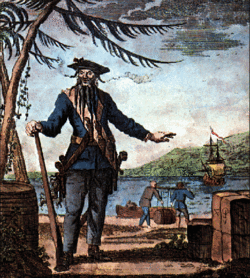
According to Capt Eric, most historians claim that Blackbeard never really killed anyone (well, hardly ever). A head taller than most men (well over 6 feet) of that era, with a wild shock of black hair and long flowing beard, he specialized in psychological warfare. Before boarding a potential prize, Blackbeard would plait long slow-burning cannon fuses into his hair and beard and light them. Wreathed in a cloud of gunpowder smoke, Blackbeard appeared to his victims as a fiend from Hell. Capt Eric related that, as he chased the terrified defenders around the deck, screaming threats, his crew would plunder the vessel unmolested. I can visualize the scene now:

Blackbeard: Aargh! I’ll have yer guts for garters, ye scurvy dogs! You’ll all walk the plank to a watery grave! Booga, booga, booga and other scary sounds!
Crewman (tapping him on the shoulder): Uh, captain?
Blackbeard: What?
Crewman: Sir, we’re done plundering. We can go now.
Blackbeard: Oh, right. Cheerio, chaps! Have a nice day. Booga, booga.

Well, maybe not exactly, but something along those lines.

Blackbeard and his crew were eventually hunted down in North Carolina’s Ocracoke Inlet by a young Royal Navy Lieutenant under the authority on Virginia’s Governor Spotswood. Blackbeard was killed in the fight and his head was lashed to the bowsprit to be brought back to Virginia. Some accounts claim his headless corpse swam around the ship seven times before striking out to sea. At least one historian pooh-poohs this because a quick extrapolation of tide charts for the area and date puts the time of Blackbeard’s death at slack low tide, with the ship sitting on the bottom in less than a foot of water.
Some say his skull was plated with silver and turned into a goblet by pirates who drank toasts to his ghost.

Wednesday, November 10, 2010

Head Bangers

The Washington Post recently ran a story about the recent spate of concussions among NFL players and how the league is reacting to them. In essence, any head shots will be punished by major fines and suspensions, even for first offenses.

Ex-Redskins linebacker and head-hunter Lavar Arrington wrote a blog on his worst concussions, both giving and getting. Arrington is the fellow who dumped Cowboys quarterback Troy Aickman on his head in the course of a vicious sack, giving him the last of a long series of knocks to the head and ending his career as a player.

Concussions are scary things—no cartoon birdies flying around your head chirping classical music, just a closing wall of dark, that at least in my case, I was able to talk my way out of and stay in this reality.

My brother, who played football in high school, was whacked more than once, but never hard enough to pass out. A friend, who was dumped on by a defensive player, remembers waking up on the sidelines with the coach saying “What’s your name, what day is it?” He says he practiced his answers beforehand so as to be able to get back into the game, but instead of “what day is it?” he was asked: “how many fingers am I holding up?” and answered “Saturday”, winning him a trip to the ER.

The most frightening concussions have got to be ones your kids get. When my son, Alec, was in eighth grade, he came home one afternoon with his glasses bent, the front wheel of his bicycle flat, and his bike helmet cracked. “I hit a rock,” was his explanation, “and got flipped over the front” (turns out he was riding down a flight of stairs and told me the rock story so as to not get into trouble). I bundled him into my truck and took him to the eye doctor to get his glasses fixed. On the way home, he complained of a headache and nausea. Alarm bells went off in the back of my skull and we skipped the last turn for home, going directly to the hospital. We walked into the Emergency Room and within a minute, he was on a gurney, headed for the MRI.

What seemed like years later (I think I aged at least that much), the doctor came in to see me. “Alec has a concussion” he said, “it’s not serious and a good thing he was wearing a helmet. Here’s the MRI scan”, he said, showing me a series of photos. I remember thinking how strange it was to be looking at my kid’s brain. “Nothing out of the ordinary” said the doctor, “All we can see here are girls and video games. Give him something for his headache, keep him quiet, and home from school for a day. He should be fine.”

I am happy for the parents of NFL players that the league is finally at least trying to keep their kids from harm. Except for any and all opponents of the Dallas Cowboys who still should be allowed to clobber them bums.

Monday, September 27, 2010

Smiles in the Stone

Last Sunday at Pat’s urging, I signed up for a gargoyle tour at the National Cathedral. I knew going in that this would not be as spectacular as the informal one I got from a maintenance worker a couple of years ago, but I was looking forward to seeing things I missed the last time around.

I found a parking spot, paid my $10, admired the play of the light through the stained glass windows on the stones, and took an elevator to the 7th floor. A docent presented a short slide show and lecture on what we would see, along with a few stories and general history. It seems that gargoyles and grotesques go way back—the Temple of Karnak has them as does Fenway Park. I learned the difference between a gablet and a pinnacle and the definition of a termination molding. Then we all rode back down to the ground and began the tour.

Of course, the docent pointed out the grotesque of Darth Vader, a carving visible as a dot way up on the North Tower (“the dark side of the Cathedral”). We saw, also way up and only discernible through binoculars, one of two medieval-style gargoyles. It seems that back in the dark ages, carvers lacked the technology to cut a hole through stone so the gargoyles of that period were done with a trough on the top…huh, who knew? He also pointed out the pair of folded hands and explained that, although most people think that they are clasped in prayer, a closer examination shows they are, in fact, gripping a golf club. What else is there to do on a pleasant Sunday?

One paired pair of gargoyles is popular with the spotters—a wealthy grandmother commissioned a pair of sculptures in honor of her two grandsons. One is shown holding a schoolbook, gazing upwards, halo firmly planted. The other, right next to it, is shown raiding the cookie jar, broken halo askew. Grandma never said which was which…wise lady.


I spent most of the tour shooting the small carvings on the termination moldings—the end bits of the gablets. Not gargoyles (all gargoyles are grotesques, but not all grotesques are gargoyles) since they lacked the spout (same root as the word “gargle”), the termination moldings are smaller and for the most part, more whimsical.

Cats and dogs peeked out the limestone. There were dragons aplenty, stylized birds, even a winged mouse.


A hippy, complete with protest sign, stash bag, and horn (??) slung over his shoulder, peered into an upper floor window. (“You have to remember,” said the docent, “that this was the sixties.”)

We soon noticed that many of the gablet terminations were in pairs—an octopus and a lobster, ostensibly ingredients in that particular stone cutter’s favorite seafood salads, shared one gablet.

Another set was left uncarved, a tribute to the one stone-cutter who died in an accident.

The best, however, is a pair depicting Master Stone-carver Vincent Palumbo and the Episcopal Bishop at the time. It seems Mr. Palumbo had an eye for the ladies (as do all Italians) and would often have his lunch on the side of the Cathedral facing the girls’ school. His admiration of the young ladies often included a wolf whistle (remember, these were the sixties, an all together more innocent time). The Bishop, whose carving shows a well-worn shoe, a tribute to his ceaseless fund raising, often admonished the Master Carver over his behavior. Mr. Palumbo assured His Eminence that his motives were purely platonic and continued his sylvan lunches. The Bishop is depicted holding his hands to his head, mouth agape in shock, reacting to Palumbo’s behavior and presumably praying for the Master Carver to stay out of Hell.


Gothic cathedrals are built to last and over a long period of time-Notre Dame was begun in the eleven hundreds, Chartes even earlier. The cathedral of Ulm in Germany was not complete for nearly 600 years. National Cathedral only took 100 years to build (1907-2007), but I expect it will be around for a thousand years. Future visitors will marvel at the archetecture and smile at the gargoyles. I hope someone still gets the jokes.

Wednesday, August 18, 2010

Gifts from the Sea Shore (with apologies to Anne Morrow Lindburg)

Whenever I go to the summer beach, I count it a successful trip if I get to see dolphins, pelicans, and osprey. Winter beaches have their own set of gifts. Pat and I went a few weeks ago to decompress and relax. We strolled the boardwalk at Bethany, took a dip or two in the cold Atlantic, ate seafood to excess, and hit our favorite bookstores. During one excellent lunch on the upper deck of a boardwalk restaurant, we watched an osprey fishing in the ocean. Hovering and diving, it grabbed a fish, and headed for the nest holding the fish head first in the talons, reminding me of a World War II torpedo bomber on patrol.

Dolphins we saw every morning, pods ambling their way south. I even glimpsed the fin of a small shark or ray in the swash of a breaking wave. No pelicans, though, no trifecta. The vague disappointment was kind of like being a kid at Christmas…presents a plenty including some you really wanted, but no Red Rider BB gun with the adjustable sights and patented lever-action loading. Just as often, though, you got something so unexpected that it made all the other stuff, actual or not, seem trivial. My unexpected present this summer was five different species of crab (OK; four, since one is technically more closely related to spiders and scorpions).

First up, while walking the beach and dodging waves in the late afternoon, I discovered (quite literally) an old childhood acquaintance, the mole crab. Bethany has been busy with beach replenishment in recent years so mole crabs haven’t been as abundant as at Assateague Island or other wild beaches. Mole crabs belie the old saying, “crabs walk sideways and lobsters walk straight”. In this case, they walk straight backwards. Mole crabs dig themselves into the upper beach almost to the limit of wave washed wet sand and sit just below the surface waiting for the next wave. As the wave washes over, they thrust out their feathery antennae and use them like tiny nets to filter out bits of debris and plankton. They draw their antennae through the mouthparts and pick out the tasty bits. The one I grabbed was a fat female, the size of my thumb (males are much smaller), scuttling on the wet sand in the backwash of a wave. I took her picture and watched her dig in and vanish as if by magic before the next wave.

As the shadows lengthened and the air began to cool from the blistering heat of the day, we repaired to the boardwalk for our evening constitutional. No visit to Bethany is complete without a lap of the boardwalk, all 5/8 of a mile of it. Near the north end, a flicker of movement caught my eye. There, in the shadow of a piling was a hole about the size of an old-fashioned half-dollar. Next to it, standing guard, was a ghost crab, again, the first I has seen on Bethany in some time. Ghost crabs are sand-colored with eyes on stalks like tiny periscopes, and run wicked fast. A mature female (big females take the beach farthest from the waves—location, location, location), she was nervously pacing back and forth by her burrow (which may be up to 3 feet deep), waiting for the gloom to deepen enough for her to set out for the beach and begin her night’s foraging—hunting mole crabs, beach fleas, and general scavenging. Now that I knew what to look for, I saw the entrances to several other burrows, some with tell-tale sand fans at the entrances indicating recent excavation. Keeping to the shadows, this one dashed a zigzag course through the compass grass, over the artificial dune, and quickly vanished from sight.

Next morning’s stroll along the beach revealed another temporary gift, a horseshoe crab. Dubbed “Delaware’s dinosaur”, it actually predates those mighty beasts by over 100 million years—truly a creature from another world. Every spring, horseshoe crabs come ashore to spawn just as they have since the mid-Permian, a third of a billion years ago. Back then, there was almost no life on land—just a few struggling primitive plants, so laying your eggs at the edge of the water was the safest thing you could do. Nobody told the horseshoe crab that things have changed in the interim—animals have evolved to live on land, including, several species of shorebirds who time their spring migrations to coincide with the spawning cycle.

Everything about this animal screams different—their blood is copper, not iron based. Horseshoe crabs’ ancient lineage predates that of crustaceans; technically, they are more closely related to trilobites and scorpions than to true crabs. Although their Latin name, Polyphemus refers to the Cyclops in the Iliad, horseshoe crabs actually have ten identifiable eyes, plus light sensitive sections on the upper and lower shell and on the tail. No problem with chewing gum and walking here—the crabs’ mouths are between their front legs, so in order to chew food, they must be walking. They swim upside down, righting themselves with the long dangerous-looking tail spine called a telson. Once on the bottom, the hydrodynamic curves of the upper shell keep them pressed to the sand—a good thing if you live anywhere near the surf zone. This one was a big female, 30 years old at least, cast up by the waves and hunkered down to wait the turn of the tide. I tossed her back into the sea with a whispered bon chance.

The beach was getting hotter and we were in desperate need of lunch. We retreated back to the house where, groggy from food and the heat, we began reading our new books in the chill of the AC. I can’t sit still for more than a few minutes so I took a walk to the local boat ramp to see what was going on. The tide in the back bay was at slack low, exposing the mud banks lining the channel. Salt marsh hay waved in the sultry breeze and laughing gulls and terns wheeled overhead. Salt marsh dragonlets, a small dragonfly and one of the few insects that can breed in salt water, hawked mosquitoes over the mud. Movement on the bank caught my eye, fiddler crabs feeding on tasty bits embedded in the mud. Females were using both small claws to shovel in the gooey mud, looking like small boys at a county fair pie-eating contest.


The slightly larger males were using their single small claw to feed, occasionally looking around and waving their huge “fiddle” claw to attract females. The motion the males use to attract females is familiar; the universal “come on over” wave. Males also use their large claw to wrestle with other males over a comely she-crab. Some males are “right clawed” others “left clawed”. I wonder what the ratio is and how they fare in combat. When I took fencing, I hated to go up against a lefty. Southpaws (or, to be more accurate, southclaws) have the advantage in an otherwise fair match—they are used to fighting the far more numerous righties and right-handed fencers are unaccustomed to fighting a mirror image of themselves. I doubt it’s so simple for fiddlers--my best guess is that the genetics will see-saw with whoever is in the ascendancy, giving the advantage to the other side in a few generations.

The tide was starting to come in, blue crabs and the occasional rockfish swam past looking for stragglers. The fiddlers were going down their burrows and pulling a plug of mud in behind them to wait out the rising water and its predators coming in from the deep. Nap time for me and the fiddlers (another gift of the beach).

Thursday, July 29, 2010

Just Another Day at the Office

Hi ho, hi ho. It was supposed to be a early tour for a group of high school kids from Louisiana. In my most recent incarnation as a tour guide giving the Ghost and Graveyard Tour in Oldtown Alexandria, I was scheduled to meet the bus at 6:45. As is often the case, the bus was late, caught in rush-hour traffic in D.C. We finally started a half-hour behind schedule. I gave a somewhat abbreviated tour, skipping a couple of stories, and finished up at Christ Church cemetery. We strolled back to the starting point at Market Square. At that point, the fun began.

According to a three-paragraph story buried in the middle of the Metro section of the Washington Post, two alleged gentlemen allegedly robbed an Arlington motel and allegedly escaped in an allegedly stolen car. Leading police in an alleged high speed chase (in Arlington? at the tail-end of rush hour? Hell, they just should have walked—would have made better time), the alleged suspects (this term was actually used by Fox “if it bleeds, it leads” News; film at eleven) made their way into Alexandria where they allegedly crashed their alleged vehicle into an allegedly parked car at Alexandria Town Hall (allegedly). One worthy hid in Alexandria Town Hall where he was found by alleged dogs and arrested (by police, not the dogs, although that does bring up an interesting mental image—“you have the right to remain silent; anything you say may be used against you and will result in a nasty bite”). The other guy stayed in the car and was arrested almost as an afterthought. The alleged suspects were held for bail without questioning (a direct quote--thanks again, Fox).

Meanwhile, I was leading my charges down King Street when sirens began to wail and multiply into a veritable symphony of hoots and honks. First one police car, then another, and another careened down the road, weaving around traffic, and blocking side streets. I began to think it was some sort of motorcade—maybe Obama was coming to Alexandria to make a speech or get a beer. I was about to make a comment (Tour Guide hint: when the primary visual object changes, change the spiel), when I noticed the cops swarming around Market Square, carrying shotguns and unholstered pistols. The tour bus was idling in front of Town Hall. A cop, red-faced from the oppressive heat, and holding a Glock 9mm, told me to get everyone inside. I told him the bus was just a half block away and he said he would get it through the barricade so the kids could board. He headed down the street, waving and shouting. The bus began to move, everyone boarded, and the bus rolled out of Alexandria in a haze of diesel smoke. As they loaded onto the bus, most of the kids remembered to say “thank-you.”

Sunday, March 7, 2010

Passages

Last Friday, at midnight, my son Alec officially turned 21. In a rite of passage as old as parenting and alcohol, I took him to a bar for his first legal drink**. I found a place nearby that was open after midnight and within walking distance. As we came in the door, my auditory system was assaulted to the edge of sensory overload shut-down by what at first sounded like an ogre having a seizure. Not to worry, it was karaoke night at the redneck bar. Alec assured me that the real song, sung by the real band, sounded the same. Kids these days.

We found a table mercifully far away from the speakers but with the decibel level still approaching that of an aircraft carrier’s flight deck during a combat mission…in a thunderstorm…during a volcanic eruption…and an asteroid strike. I ordered a pitcher from the barmaid, and mentioned it was for the birthday boy. Alec passed over his driver’s license and she confirmed that he was indeed, 21 years old by a full 5 minutes. “Happy birthday” she said and went to fill our order. She was back shortly with a pitcher of Bud and a glass. “On the house”, she said, placing the glass in front of Alec. “It’s a Four Knights—Jimmy, Jack, Johnny, and Jose,” That would be Jim Beam, Jack Daniels, Johnny Walker and Jose Cuervo to the uninitiated. Alec took a sip, made a face, and passed it over to me. I tasted it; not bad, although Four Horsemen would have been a better name-just what you need to get through the appocylypse. I passed it back to Alec who slammed it down, chasing it with a beer. Kid’s been getting some practice I thought. As Alec and Craig, his newly arrived friend from back in high school, began looking over the karaoke selections, my reverie was broken by a pseudo-good ole boy in a black Stetson doing a voice-over to “Okie from Muscogee”. Jeeze, I thought, I haven’t heard that song since before my son was born. Funny how things change but pretty much stay the same—If you change the words in the line: “White lightning’s still the biggest thrill of all” to “Home-made meth” you still pretty much retain the essence of the song…well, maybe not. Time for another pitcher.

Alec and Craig were called up to the stage by the karaoke master for their selection. “But first, it’s Alec’s 21st birthday.” The DJ said, “Everyone join me in wishing him a good one.” The bar burst into song, following the age old rule of if you can’t sing it well, sing it loud.

Alec chose a song, “Just a Gigolo” by David Lee Roth, formerly of the head-banger band Van Halen. He didn’t really know the words and read his way though it to the end, not too bad; He got hung up on the scat singing la-la-la part but the bar gave him a rousing ovation anyway. He and Craig joined in a duet of the Beatles’ “Revolution”; again, same result. Don’t quit your day job.

I poured the rest of the pitcher, and asked for the check. Alec raised his glass to me and said “Happy birthday, Pop.”

**Note to Parents: In no way should this be construed as a “first drink”—this is just a first legal drink, eliminating the 3 a.m. phone call: “Mr./Mrs. insert name here , this is Officer insert name here, of the insert name here police department. We have you son/daughter, insert name here on a drinking under age charge and would like you to come down to the station house as soon as possible.”

Saturday, February 27, 2010

One of the Boys

I suppose most of us, in our own minds, think we lead pretty unexciting lives. Barak Obama, in his secret life, wishes he were an NBA star—hell, even James Bond probably fantasizes life as a NASCAR driver. I’m no different, except no one I know has ever been called in to an FBI interrogation.

It was in the carefree spring of 1973. You remember; peace, love, equal rights for vegetables. A newly minted college graduate, I was in grad school, part-time at night, and working construction to make ends meet. Not only was I the only college graduate on the laborer crew, I was the only one without a prison record. Lunch conversations were embarrassing—one fellow had done five years for grand-theft auto, another had shot a man five times in a bar fight. Me? I got a ticket once for passing a school bus. I tried to fit in; smoked Camels, the pack rolled up in the sleeve of my t-shirt, shot craps behind the foreman’s trailer on Fridays after work. I even used the “f word” as an all-purpose modifier in my speech. Nothing seemed to work; I would always be the college kid, the misfit, the nerd.

One Tuesday evening after class, my friend Freddy talked me into attending the circus. No, not the Ringling Brothers variety, a small, one ring, European, family circus was touring colleges around the East Coast. They were performing one night only on campus and admission was free. I said OK and we went. Acrobats, aerialists, a trained bear, great fun. I noticed that all the performers with the possible exception of the bear, all seemed related—family circus indeed.

I was giving Freddy a ride back to his place when my car was nearly blown off the road by a passing fire engine headed someplace in a big hurry. “Cool!” Freddy said, “Let’s see where they’re going.” Sure, I thought, why not. I followed the truck to the parking lot of the campus armory, where it joined other pieces of equipment already there. The firemen, all volunteers, and all woefully undertrained, leapt from the engine, and began running around, tripping over hoses running into each other, and acting like act II, the comedy part, of the circus we had just left. The only thing missing from the whole fiasco was the fire. No flames, no smoke, not brave firemen rescuing fainting maidens from upper story windows. “Huh,” Freddy shrugged, “I thought it would be better than this. Let’s go.”

Next day, I was digging a hole when the foreman emerged from his trailer. “Al,” he shouted, “call your mother.” My stomach turned, nobody ever got a message from the foreman to call home unless it was something dire. Did my dad have a heart attack? Brother in a car wreck? Heart pounding, I made the call from a pay phone. “The FBI called” my mom said, “I didn’t tell them anything.” My mom was a war bride, having grown up in Nazi occupied Europe. When the authorities came calling, you didn’t say anything. She gave me the number and I made the call.

“Agent Van Dorn speaking.” Came the reply. I identified myself and asked what was the problem. “The armory at the University was firebombed last night and someone saw your car leaving the scene. We would like to talk with you.” “Okay…” I said, “I can take off from work and meet you at your office.” “No no,” Agent Van Dorn replied, “I don’t want to make you miss too much time. Let’s meet off Route 29; there’s a parking lot by the Giant.” This was beginning to sound like a bad cop show. I had visions of large, heavily armed men in flack jackets with instructions to take no prisoners surrounding my car. “It’s ok,” I said, “I can come to your office to discuss this. No problem.” I got the directions from a disappointed sounding Agent Van Dorn and told the foreman I was going to an FBI interrogation.
A half-hour later, I was walking into the FBI field office in Silver Spring. I was dirty, my jeans and work boots encrusted in mud, and leaving muddy footprints on the polished tile floor. I was escorted to an interrogation room and left to wait. I began to wonder just what I had gotten myself into. One wall was covered by a large mirror, doubtless two-way, and a photo of the J. Edgar Hoover Marksmanship Trophy, presented to Agent Van Dorn, adorned the other wall. Two large men came in. Agent Van Dorn, almost certainly, along with another agent. Both men were in dark suits, dark ties, and pocket handkerchiefs. Standard FBI garb. Agent Van Dorn read me my Miranda rights and repeated what he had told me over the phone. He asked what I had been doing at the scene of the crime. I told him all about the circus and the fire engine. I ended by saying “It was like when you’re a kid, and a fire engine goes by—you just want to see where it’s going.” Agent Van Dorn smiled and nodded. “Yeah,” he said, “you don’t have to be a kid to enjoy a good fire.” A phrase that would resonate in my head for probably the rest of my life. He thanked me for my time, took the names of corroborating witnesses, and told me if anything further came up, he would contact me. I was free to go.

When I arrived at the job site the next day, Jack, the biggest baddest dude on the laborer crew came up to me and said “I hear you were questioned by the FBI.” Apparently the foreman had passed the word. “Yeah,” I said, “No big deal.” I noticed the other guys on the crew began to talk to me more, joking and offering smokes. It dawned on me…I finally fit in; I had street cred.

Saturday, February 20, 2010

The Departed

The thing about ghost stories is that, although each has a central core, something that always stays the same, details differ with whoever is telling it. And ghost stories should be told. They are part of a human tradition as old as language itself. When such a story is locked in print, something is lost—the printed version becomes the baseline, the unimpeachable source against which all facts are measured.

Take the case of Alexandria’s Female Stranger. The truth, as far as anyone can reasonably determine, is that in September 1816, a ship, bound from the West Indies, docked at the Alexandria wharves. A young couple disembarked, the woman very ill, probably with typhoid or yellow fever. They took a room at Gadsby’s Tavern. A physician was called as well as a pair of nurses. The husband requested the doctor and nurses, as well as the inn-keeper’s wife, swear an oath never to reveal the couple’s name. Tragically, the young woman, declining all the while, died in her husband’s arms in October. She was (some say, secretly) buried in St. Paul’s Cemetery under a headstone with the name “Female Stranger”. The young man disappeared and the doctor and nurses kept their vows, never revealing the names. End of the facts as written—the mystery now becomes legend.

Depending on who is telling or writing the story, things take off from there. Speculation on the couple’s identity ranges from the daughter of Aaron Burr, to the disgraceful outcome of a love triangle ending in a fatal duel and furtive flight. Some stories have the young man dying in prison while others have him moving up the Potomac and becoming a recluse, overcome by grief, and living in a lonely ramshackle cabin by the river’ edge. He journeyed regularly down river to Alexandria to visit his beloved’s grave. Since nothing was known about him, locals took to calling him “John of the Cabin” or simply “Cabin John”. The name lingers today in a small community on the Maryland side of the river.

Another version of the story, told in Gadsby’s Tavern, concerns a beautiful young woman, who, dressed in the style of the early 19th century, frequented formal dances held in the ballroom on the second floor. The ballroom was down the hall from the room taken by the unknown couple years earlier. She never spoke or danced with any would-be suitors, and always slipped away before the festivities ended. One evening during the Civil War, a smitten young Union officer followed her as she left the ball, hoping to strike up a conversation with this mysterious beauty. Upon entering the room down the hall, he found it empty, with a lamp lit in the corner. He notified the manager of an unattended flame and the two went back to the room. When they got there, the room was dark and the candle wick in the lamp was unblackened—it had never been lit. As the puzzled young officer was leaving the room, he touched the glass globe of the unlit lamp. And burned his fingers.

As a student of the paranormal once said: If you believe, no explanation is necessary; if you don’t, no explanation is possible.

Saturday, February 13, 2010

Interglacial

It’s official, we’re number one—the D.C. area has broken the record for snowfall set in the winter of 1899. Hooray. We topped the charts at 55.6 inches of the stuff. This may seem trivial to someone from oh, say, Buffalo where they probably get this much in August, but then we don’t have the experience or the equipment to deal with a snowpocalypse of these proportions. Drinks on the house. Little kids, when they are old and creaky, will tell their grandchildren “I remember back during the winter of aught 10. You couldn’t see above the snow and we had to walk to school in the blizzard. Up hill. Both ways. And the snow was flying, the wind was blowing, the wolves were howling and the volcano was erupting to boot.” Sure grandma. Maybe some future president has noted the ungodly amounts of snow in his or her journal just like Washington and Jefferson did back in the terrible winter of 1722.

Here in Northern Virginia, we get ready for a big snow by emptying the stores. Bread, milk, and toilet paper are the first to go. My daughter and I thought we would be clever and went to the supermarket two days before the onslaught of the first big storm back in early February. Ha! Shelves were already empty and we waited to check out for an hour and a half. The line actually did move, people were friendly, and we spent the time playing word games involving the contents of our cart.

Come the snow, and I was getting cabin fever at inch two. I took walks with the dog, spent time on line, worked on projects as the snow began piling deeper throughout the weekend. When it was over and the familiar sound of shovels on pavement began to ring through the neighborhood, I went out and cleared the sidewalk and driveway. Not too bad a job, thank god for ibuprofen. When the next set hit, it was more of the same, except this time it took longer and longer to make any headway. It wasn’t so much shoveling as it was trenching—I felt like a World War I doughboy. My neighborhood now looks like trench warfare has broken out.

Cars in their driveways sit in snow revetments, waiting on the barrage.

Uncleared cars are humps in the snow covered landscape, looking for all the world like igloos with sideview mirrors. Snow plows leave several feet of snow in their wake, which needs to be moved before it turns to ice.

I dig down to the lower layers of where I think the sidewalk went and flashes of blue spark and glimmer. This is the color of glacier ice. It is also an early symptom of snow blindness where enough UV hits your retinas to cause sunburn. The worst part is when the retinas peel just like the skin on your arms at the beach. I’m told it feels like sand in your eyes. Antarctic explorers don’t wear sunglasses to look cool.

My bird feeders, filled just before the blizzard, are doing a land office business. The smaller birds have been supplanted by the big boys—starlings, blue jays, and the occasional woodpecker, all feeding on sunflower seed and suet. The little guys have to make do.


Snow is patient—this is how ice ages start. Pile it up high enough and it will last through the summer, to form a base for the next winter’s offerings. Keep it up long enough and the bottom layers compress to ice. Or you could just run a car over it a few times. Some of this stuff will still be here in June, remembering the glory days of the Pleistocene, which in geological terms, was only a few hours ago. Keep in mind—even with all the fuss about global warming, we are in what geologist call an “interglacial period”—the ice will be back. I think my driveway will be the tipping point causing the next advance of ice.