“You need a new phone.” It was true; my cell phone seemed to have something wrong with it. For starters, the battery seemed wonky. Every night when I placed it in its charging cradle, it said “charging”, but an hour after I slipped it into my pocket, it would bleat at me- “Low battery”, “Feed me" it flashed. That, plus the fact that I could neither send a message nor receive one, convinced my tech-savvy daughter that a new unit was in order.
Bright and early the next day, phone flashing “Feed me”, we trundled off to the phone store. Ariel stopped by the door at a bank of screens and signed us in. “What’s your number?” she asked before filling in a crucial data line marked with an asterisk to indicate it was a crucial data line. I had no idea, having never called myself on my cell. “No problem,”, she whipped out her phone, one of those sleek jobs that open either vertically or horizontally, depending on intended use, and checked my number in her favorites list. We were in the system and shortly a bright young man asked us how he could help us. I explained the problem and he grew solemn. Taking my phone he asked “How old is this?” I had no idea. “Must be four or five years old” he muttered and called over a co-worker. “Have you ever seen one like this before?” he asked, making my phone sound like something Lee used to text message Pickett at Gettysburg just before the big assault. “You need a new battery, but I don’t think we have anything this old in stock. We can special order one from the Nokia factory in Finland or we can give you an upgrade.” He led us over to the display phones, pointing out various features. “GPS, 64 HD rez, 15mega-whoozies, voice recognition artificial intelligence, recyclable nuclear power, heads-up graphics display, aps for choosing restaurants, hailing cabs, and leveling paintings on the wall, as well as time warp capabilities. Whadya think?”
“I’m just looking for something I can call with and text.” I said, feeling a bit like Fred Flintstone in a Jetsons cartoon. “No problem,” came the answer, “We’ve got just the thing.” He steered me to a black Samsung; menu button, contacts button, no frills. Fine. Deal done, I took a good look at my new hand-held communications device. Wait. This is a phone for an old person, maybe a preschooler. Nice big number buttons. A dedicated 911 button in case I fall and can’t get up, an ICE button to be used for emergency contacts in case I fall and can’t get up and forget that 911 is an emergency button, and a Health Info button in case I fall and not only can I not get up but forget how to call for help. Even the menu has a line in big red letters for emergency contacts. This is a phone for a true hypochondriac, or maybe something to use while digging out of the steaming wreckage from the latest hurricane or earthquake. This is not your father’s Oldsmobile—wait, it’s your grandfather’s Oldsmobile. Huh. Oh well, as long as it gets me from here to there.
Wednesday, April 15, 2009

Saturday, March 21, 2009
Civilization
I felt more than heard the screeching brakes. Every cell in my body went into a fetal crouch as the voice in my head screamed (not for the first time that weekend) “You’re going to die. You’re going to be mashed flat by a Citroen taxi cab in the middle of Paris.”
I had arrived upon the point of messy death in a somewhat round-about manner. My traveling companion Jeff and I had arrived a few hours earlier on an Air France flight from Khartoum, Sudan, with a stop for refueling in Cairo, and had struggled with bureaucracy every foot of the way. As we went through what passed for airport security in Khartoum airport, one of the security people took exception to my Swiss army knife, and confiscated it. He handed me a hand-written note in Arabic with the instructions to give it to the pilot when we arrived in Paris. “Fine”, I thought—I understood that a knife, albeit one with a three-inch blade, could pose a risk, but what about the nine-millimeter pistol the fellow behind me turned over and was given back after the security person ensured that the clip was fully loaded?
At least the Air France A10 Air Bus was roomy and comfortable, unlike the Air Sudan 727 we had ridden from Port Sudan to the capitol. We made the mistake of leaving just before the start of Ramadan, the holy month when everyone travels to be with family or just someplace else. To say the flight was overbooked was a bad joke. It reminded me of seventh graders on a school bus. People were standing in the aisles. Carry-ons filled the rest of the floor space. No in-flight snacks here--the flight attendants had sold their own seats, and presumably all the bags of peanuts as well. The aircraft was easily carrying half-again as many passengers as rated. “Oh Christ,” I remember thinking as the overloaded jet charged down the runway, “We’re all going to die in a third-world country, and no one will even bother to look for us.” The 727 clawed its way into the air, delivering us to Khartoum and to a real airline.
As we followed the Nile north,I saw Lake Nasser and Abu Simel, a toy in the Sahara as we passed. We banked over Giza and everyone rushed to the left side of the aircraft to see the Pyramids. Luckily, the pilot compensated for the sudden weight shift and effected a smooth landing in Cairo for refueling.
Cairo to Paris was uneventful. We were fed real food from real plates with real tableware embossed with the Air France logo and we weren’t even first class. We passed over Naples and its attendant volcano, Vesuvius. From the air, the Bay of Naples is nearly circular. Sort of like photos of volcanic calderas. Gives you pause; you can almost hear the ticking. Once we were on the ground, I waited to leave the plane and handed the pilot the receipt for my knife. Surprise, he had no idea what it was. I guess the security guy in Khartoum needed a Swiss Army knife. I hope he cut himself.
Paris. City of Lights, center of civilization and Western culture, and a major reverse culture shock. After three months in the bush, electricity and traffic were somehow out of focus. No herds of camels in the streets, no loudspeakers calling the faithful to prayer. We cruised the line of taxis outside the terminal building at Charles de Gaulle Airport looking for someone who spoke English. I had assumed that Jeff, who gave off a Humphrey Bogartesque world weary air, spoke French--Hell, he even smoked Galois cigarettes. “Not a word”, he said, leaving me to dredge up mostly forgotten high school lessons. “Parle-vous Ainglais?” I asked the first cabbie in line. He narrowed his eyes under his beret, shifted his cigarette from one corner of his mouth to the other, and said “Non”—unspoken was the tagline, “and I spit on you for asking, American pig-dog.” We dragged our duffel bags down the line and finally found a younger fellow who said “But of course”. I was ready to gag on clichés, but we loaded up and piled in. I told the cabbie we needed a cheap place for our one night layover in his wonderful city. He took us through the city, showing off the sights, Notre Dame, Sacre Cour, until we arrived at a small building within sight of the Arc de Triumph. “This is a pension run by my cousin” he told us. “He will take care of you.” Dog-tired we stumbled into the lobby and signed in. The cabby’s cousin directed us to a local bistro and off we went, searching for real French food and wine.
Our search led us down the Camps d’Elese and being American, we found an English bar. The Winston Churchill Pub promised distilled spirits and, most importantly, beer. We stopped for a round, and resumed our search for French food. The bartender, from Liverpool, told us of a bistro not far off that “had the best bleedin’ steak au poive in France, mate.”
We crossed a wide street, hurrying on the unfamiliar lights cycle, when I was stopped dead in my tracks. Walking toward me was one of the most beautiful women I have ever seen. Forget that I had spent the past three months in the bush, forget that I was terminally jet lagged and completely bushed, and forget that I had just consumed two excellent Scotch wiskys on an empty stomach. She was lovely. Tall, blonde, short dress, with legs reaching all the way to the ground, she walked oblivious to the stares and sidelong glances from the people around her. Me, I was dumbstruck, gob smacked. I stood in the middle of the street and watched her pass, my cigarette falling from my mouth open in frank astonishment and ignorance of the changing stop light and the onrushing traffic.
I looked down to see a chrome bumper inches from my knees. It must have actually touched the fabric of my jeans before rocking back to rest. A steady stream of what must have been, judging from the volume and passion involved, the most vile of Gallic curses penetrated into my shell-shocked brain. The cabbie was leaning out the driver-side window, shaking a fist and shouting. Flecks of saliva were floating in the street lights. I looked down again and at his purple face distorted with rage. I shrugged. “Hey,” I yelled back, “I’m American.” Almost instantly the invective stopped. The driver gave a small smile as if to say “oh, American, you’re supposed to be stupid No problem, mon ami.” I hurried across the street and rejoined Jeff who had missed the whole drama while watching the girl recede down the crowed sidewalk.
We spent the entire rest of the night wandering around Paris, savoring its sights, sounds, smells and music. We walked by the floodlit Arc d’Triumph, the Eiffel Tower white lights up its entire length. We strolled wide boulevards; still packed at 3AM, and lurked down dark side streets where we were told to move on by armed guards (“just keep walking”). When we at last got back to our pension, stumbling from Absinthe and exhaustion, it was only to gather our stuff and head for the airport and home.
Jeff left the company soon after. At his farewell lunch, he told me “I’m sure both of us had a list of fifty other people we would rather have been there with, but it was fun.” “Yeah”, I replied, “we’ll always have Paris.”
I had arrived upon the point of messy death in a somewhat round-about manner. My traveling companion Jeff and I had arrived a few hours earlier on an Air France flight from Khartoum, Sudan, with a stop for refueling in Cairo, and had struggled with bureaucracy every foot of the way. As we went through what passed for airport security in Khartoum airport, one of the security people took exception to my Swiss army knife, and confiscated it. He handed me a hand-written note in Arabic with the instructions to give it to the pilot when we arrived in Paris. “Fine”, I thought—I understood that a knife, albeit one with a three-inch blade, could pose a risk, but what about the nine-millimeter pistol the fellow behind me turned over and was given back after the security person ensured that the clip was fully loaded?
At least the Air France A10 Air Bus was roomy and comfortable, unlike the Air Sudan 727 we had ridden from Port Sudan to the capitol. We made the mistake of leaving just before the start of Ramadan, the holy month when everyone travels to be with family or just someplace else. To say the flight was overbooked was a bad joke. It reminded me of seventh graders on a school bus. People were standing in the aisles. Carry-ons filled the rest of the floor space. No in-flight snacks here--the flight attendants had sold their own seats, and presumably all the bags of peanuts as well. The aircraft was easily carrying half-again as many passengers as rated. “Oh Christ,” I remember thinking as the overloaded jet charged down the runway, “We’re all going to die in a third-world country, and no one will even bother to look for us.” The 727 clawed its way into the air, delivering us to Khartoum and to a real airline.
As we followed the Nile north,I saw Lake Nasser and Abu Simel, a toy in the Sahara as we passed. We banked over Giza and everyone rushed to the left side of the aircraft to see the Pyramids. Luckily, the pilot compensated for the sudden weight shift and effected a smooth landing in Cairo for refueling.
Cairo to Paris was uneventful. We were fed real food from real plates with real tableware embossed with the Air France logo and we weren’t even first class. We passed over Naples and its attendant volcano, Vesuvius. From the air, the Bay of Naples is nearly circular. Sort of like photos of volcanic calderas. Gives you pause; you can almost hear the ticking. Once we were on the ground, I waited to leave the plane and handed the pilot the receipt for my knife. Surprise, he had no idea what it was. I guess the security guy in Khartoum needed a Swiss Army knife. I hope he cut himself.
Paris. City of Lights, center of civilization and Western culture, and a major reverse culture shock. After three months in the bush, electricity and traffic were somehow out of focus. No herds of camels in the streets, no loudspeakers calling the faithful to prayer. We cruised the line of taxis outside the terminal building at Charles de Gaulle Airport looking for someone who spoke English. I had assumed that Jeff, who gave off a Humphrey Bogartesque world weary air, spoke French--Hell, he even smoked Galois cigarettes. “Not a word”, he said, leaving me to dredge up mostly forgotten high school lessons. “Parle-vous Ainglais?” I asked the first cabbie in line. He narrowed his eyes under his beret, shifted his cigarette from one corner of his mouth to the other, and said “Non”—unspoken was the tagline, “and I spit on you for asking, American pig-dog.” We dragged our duffel bags down the line and finally found a younger fellow who said “But of course”. I was ready to gag on clichés, but we loaded up and piled in. I told the cabbie we needed a cheap place for our one night layover in his wonderful city. He took us through the city, showing off the sights, Notre Dame, Sacre Cour, until we arrived at a small building within sight of the Arc de Triumph. “This is a pension run by my cousin” he told us. “He will take care of you.” Dog-tired we stumbled into the lobby and signed in. The cabby’s cousin directed us to a local bistro and off we went, searching for real French food and wine.
Our search led us down the Camps d’Elese and being American, we found an English bar. The Winston Churchill Pub promised distilled spirits and, most importantly, beer. We stopped for a round, and resumed our search for French food. The bartender, from Liverpool, told us of a bistro not far off that “had the best bleedin’ steak au poive in France, mate.”
We crossed a wide street, hurrying on the unfamiliar lights cycle, when I was stopped dead in my tracks. Walking toward me was one of the most beautiful women I have ever seen. Forget that I had spent the past three months in the bush, forget that I was terminally jet lagged and completely bushed, and forget that I had just consumed two excellent Scotch wiskys on an empty stomach. She was lovely. Tall, blonde, short dress, with legs reaching all the way to the ground, she walked oblivious to the stares and sidelong glances from the people around her. Me, I was dumbstruck, gob smacked. I stood in the middle of the street and watched her pass, my cigarette falling from my mouth open in frank astonishment and ignorance of the changing stop light and the onrushing traffic.
I looked down to see a chrome bumper inches from my knees. It must have actually touched the fabric of my jeans before rocking back to rest. A steady stream of what must have been, judging from the volume and passion involved, the most vile of Gallic curses penetrated into my shell-shocked brain. The cabbie was leaning out the driver-side window, shaking a fist and shouting. Flecks of saliva were floating in the street lights. I looked down again and at his purple face distorted with rage. I shrugged. “Hey,” I yelled back, “I’m American.” Almost instantly the invective stopped. The driver gave a small smile as if to say “oh, American, you’re supposed to be stupid No problem, mon ami.” I hurried across the street and rejoined Jeff who had missed the whole drama while watching the girl recede down the crowed sidewalk.
We spent the entire rest of the night wandering around Paris, savoring its sights, sounds, smells and music. We walked by the floodlit Arc d’Triumph, the Eiffel Tower white lights up its entire length. We strolled wide boulevards; still packed at 3AM, and lurked down dark side streets where we were told to move on by armed guards (“just keep walking”). When we at last got back to our pension, stumbling from Absinthe and exhaustion, it was only to gather our stuff and head for the airport and home.
Jeff left the company soon after. At his farewell lunch, he told me “I’m sure both of us had a list of fifty other people we would rather have been there with, but it was fun.” “Yeah”, I replied, “we’ll always have Paris.”
Sunday, March 8, 2009
Observations
We hit meteorological spring earlier this week. Today the thermometer topped out at 51º but snow hides in hollows and on north facing slopes. Squirrels are starting their courtship chases spiraling around tree trunks. Crows still hold to their winter conclaves, festooning bare branches like macabre ornaments on the Adams family’s Christmas tree.

In my front yard, two snow drops and a lone brave crocus have pushed their way through the damp soil to proclaim the glaciers’ retreat. It’s as if the pendulum of the seasons is poised at the top of the upswing, in that moment when time stops, before the earth draws breath and real spring can start.
This is crunch time for most animals. The bounties of autumn are exhausted and the promise of spring stays just that. The Jamestown settlers called late winter/early spring the “starving time”, raiding Indian food caches and resorting to cannibalism for survival. New England Pilgrims suffered appalling losses before spring supply ships could arrive.
My backyard feeders are depleting at twice their usual rate. The skeleton crew of year-round birds is beginning to prepare for breeding and the species that winter here are trying to put on weight for the long trip north. I am seeing juncos for the first time this year and goldfinches have shown up as well. Goldfinches are becoming more yellow by the day as their drab winter plumage wears away. Males are calling, setting up territories and then trying to defend them against all comers. House finches, gather in rows at the feeder, the males glowing red with breeding passions. Social birds, house finches do not establish territories—females go with the reddest males.


We have had five species of woodpeckers coming to our feeders. They hang around at the suet cage, waiting their turn to gorge on the calorie-rich fat. Four wait—they all give way when the local pair of pileateds deigns to make an appearance. To their lordship’s credit, they usually work the backyard trees, leaving my humble offerings to the peasants. A pileated can bang its way through a moderate sized branch in a few minutes using its barbed harpoon-like tongue to lap up insects from their wood tunnels.


The silver maple in the corner of my yard is in flower, pumping out pollen to the breeze, and the red maple nearby is nearly ready to go. Elms downtown are yellowing windows and puddles with copious pollen. The catkins on the river birch at the end of the street are swelling and will be streaming pollen by the end of the week.
Yellow perch are spawning in tidal creeks, long ribbons of eggs tangling on submerged branches. Shad roe from the Carolinas in the grocery store, the gentleman manning the fish counter patiently answering the same questions he’s heard a hundred times already in the last week. “Sauté them with bacon and don’t overcook.” The fish are protected in the Chesapeake and no local roe is available when the Potomac shad make their spawning runs. Shad season has been pushed forward in the mid-Atlantic.
Skunk cabbage is poking out of wet places, luring early flying flies to the flowers with their perfumes of rotting meat. Skunk cabbage can generate metabolic heat, melting their way through snow and ice, providing a warm place for pollinators to rest and lay eggs. It’s all sham, though. The heat fades with the flowers and the larval flies starve in the depths of the flower. The dime-sized harbinger of spring at least provides nectar for the solitary bees who visit its flower clusters, arranged like parabolic reflectors and tracking the sun through the day. Most of the spring wildflowers due in the next month have the same general shape and behavior.
Spring is peeking in the windows, getting its foot in the door. Each species, plant and animal, runs on its own calendar. For some, it is still the dead of winter, for others, it’s time to get going. Most, however, are hitting the snooze button and turning over for a quick last doze.

In my front yard, two snow drops and a lone brave crocus have pushed their way through the damp soil to proclaim the glaciers’ retreat. It’s as if the pendulum of the seasons is poised at the top of the upswing, in that moment when time stops, before the earth draws breath and real spring can start.
This is crunch time for most animals. The bounties of autumn are exhausted and the promise of spring stays just that. The Jamestown settlers called late winter/early spring the “starving time”, raiding Indian food caches and resorting to cannibalism for survival. New England Pilgrims suffered appalling losses before spring supply ships could arrive.
My backyard feeders are depleting at twice their usual rate. The skeleton crew of year-round birds is beginning to prepare for breeding and the species that winter here are trying to put on weight for the long trip north. I am seeing juncos for the first time this year and goldfinches have shown up as well. Goldfinches are becoming more yellow by the day as their drab winter plumage wears away. Males are calling, setting up territories and then trying to defend them against all comers. House finches, gather in rows at the feeder, the males glowing red with breeding passions. Social birds, house finches do not establish territories—females go with the reddest males.


We have had five species of woodpeckers coming to our feeders. They hang around at the suet cage, waiting their turn to gorge on the calorie-rich fat. Four wait—they all give way when the local pair of pileateds deigns to make an appearance. To their lordship’s credit, they usually work the backyard trees, leaving my humble offerings to the peasants. A pileated can bang its way through a moderate sized branch in a few minutes using its barbed harpoon-like tongue to lap up insects from their wood tunnels.


The silver maple in the corner of my yard is in flower, pumping out pollen to the breeze, and the red maple nearby is nearly ready to go. Elms downtown are yellowing windows and puddles with copious pollen. The catkins on the river birch at the end of the street are swelling and will be streaming pollen by the end of the week.
Yellow perch are spawning in tidal creeks, long ribbons of eggs tangling on submerged branches. Shad roe from the Carolinas in the grocery store, the gentleman manning the fish counter patiently answering the same questions he’s heard a hundred times already in the last week. “Sauté them with bacon and don’t overcook.” The fish are protected in the Chesapeake and no local roe is available when the Potomac shad make their spawning runs. Shad season has been pushed forward in the mid-Atlantic.
Skunk cabbage is poking out of wet places, luring early flying flies to the flowers with their perfumes of rotting meat. Skunk cabbage can generate metabolic heat, melting their way through snow and ice, providing a warm place for pollinators to rest and lay eggs. It’s all sham, though. The heat fades with the flowers and the larval flies starve in the depths of the flower. The dime-sized harbinger of spring at least provides nectar for the solitary bees who visit its flower clusters, arranged like parabolic reflectors and tracking the sun through the day. Most of the spring wildflowers due in the next month have the same general shape and behavior.
Spring is peeking in the windows, getting its foot in the door. Each species, plant and animal, runs on its own calendar. For some, it is still the dead of winter, for others, it’s time to get going. Most, however, are hitting the snooze button and turning over for a quick last doze.
Tuesday, February 3, 2009
Scorps and Smuggled Hootch
So there I was, three and a half sheets to the wind, standing so close to the middle of nowhere that we were in the same area code, in the dark, with it about to become much darker. I was holding a well and truly ticked off four-inch long scorpion in my right hand in the only way that a primate with opposable thumbs can hold one safely. And on top of everything else, I had to pee. Badly.
I can hear the questions now. “Was it poisonous?” All scorpions are poisonous-that’s how they work. Was it deadly? The rule of thumb is the smaller the animal, the more toxic the venom. This one was nearly the length of my hand, so by the rule of thumb, it probably wasn’t deadly to humans. There was only one way to run the experiment and I really didn’t want to play, having grown attached to my thumb.
“How did you get yourself into this predicament?” I was in eastern Sudan, north of the Tropic of Cancer, just south of true desert, on an AID-financed expedition to control desert locusts. The locusts were late that year, so the team went to Plan B, studying the other animals in the area and determining what alternatives to DDT were least harmful to them. We also collected specimens from this seldom visited part of the world for friends and acquaintances at the Smithsonian.
“No, how did you get yourself into a situation from a bad movie or a funny cartoon?” We had a generator; the only electricity for a hundred miles in any direction. We had a TV and a VCR. We had two tapes. Two really bad movies; they were the only ones the US embassy in Khartoum was willing to part with and I really don’t remember either one. Suffice it to say, we had watched them both dozens of times just to pass the time between sunset and 10 pm when the generator kicked off. We had pooled our carefully hoarded snacks-a bag of mostly crushed chips, a few dented granola bars, a couple of squares of half-melted chocolate, and declared a movie night (again). What made this night special, were the two bottles of smuggled Ethiopian gin supplied by Paul, our camp manager, an ex Foreign Legion paratrooper. He bought them from gun runners supplying AK-47s and grenade launchers to Eritrean rebels about 50 kilometers south. At night we could hear their trucks off in the distance, a faint glow of masked headlights reflecting off the sand from miles away. Paul had picked up a case of Asmara gin from a smuggler headed north for another load of munitions. He said it was purely medicinal and claimed that, as a chronic malaria sufferer, the only cure for an attack was to get as drunk as possible, as quick as possible, for as long as possible. I don’t know if it helped the malaria any but it helped him pass the time.
The movies tracked, the gin was passed around and around and around. We timed the party to break up with ten minutes to spare before lights out. Lights out was the real deal. When the generator shut down, the entire camp went black. You could, if you had enough time for your eyes to adjust, make it to the latrine by starlight. The shack was black and white stripped so as to stand out in the darkness.
With unsteady steps and sloshing bladder, I wove my way toward the aforementioned convenience when a movement in the shadows at my feet caught my eye. “Gerbil” I thought and made a barehanded grab. This is not as crazy as it may sound—biologists are always grabbing specimens. Nets are usually just an ornament. The great Charles Darwin himself, collecting beetles saw a rare specimen while holding a beetle in each hand. He popped the left hand beetle in his mouth and grabbed, securing all three.
Of course it helps to make a good identification of what ever it is you are snatching at. An entomologist friend once grabbed a red velvet ant. Red velvet ants are wingless wasps, covered in red and black striped fur. Anything red or orange is warning you not to mess with it. Discretion is called for if not demanded. Heed the warning and you both walk away unscathed. Ignore it at your peril. My friend grabbed anyway and was stung twice before he could register what he had. His hand swelled to catcher’s mitt proportions and he only made it through the night with liberal applications of Benadryl and scotch.
I grabbed at the gerbil with my right hand. Small mammals are easy to grab. The worst they can do is bite. OK, so you get a mouse bite. Big deal; that’s the worst it can do on its way to the big museum in the sky. As soon as my hand closed on it, the still thinking part of my brain fired off a message: “Not a gerbil”. The next message, delivered, postage due, was: “Something bad.” They say God looks after fools and drunks and that night I was both. Pure blind dumb luck had me holding the scorpion, for that’s what my brain finally decided it was, just inside the last segment of the tail. That last segment was the one with the nuclear warhead. The scorpion wiggled in my grasp like an enraged miniature lobster, pinching me with its claws. Part of my thinking processes were going: “What a cool animal” other, more rational, parts were going: “Now what? You can’t drop it or it will nail you as soon as you let go. There is no doctor within a hundred miles and no hospital until you get to civilization. Oh, and by the way, the lights are going out any minute.”
I half ran half staggered back to the tent where the TV and gin were. My brain, helpful as ever, was chanting a mantra: “Don’t pass out, don’t throw up. Don’t pass out, don’t throw up.” I found an empty pint jar and a half full bottle. Using my teeth, I unscrewed the cap and poured the gin into the jar. I eased the scorpion, head first, into the gin and held it until it quit moving. As the lights cut out, I capped the jar, took a swing from the bottle, and walked with exaggerated care in the dark back to my tent and flopped down on my cot, hoping I wouldn’t dream. I’m sure that somewhere, Darwin was laughing.

I can hear the questions now. “Was it poisonous?” All scorpions are poisonous-that’s how they work. Was it deadly? The rule of thumb is the smaller the animal, the more toxic the venom. This one was nearly the length of my hand, so by the rule of thumb, it probably wasn’t deadly to humans. There was only one way to run the experiment and I really didn’t want to play, having grown attached to my thumb.
“How did you get yourself into this predicament?” I was in eastern Sudan, north of the Tropic of Cancer, just south of true desert, on an AID-financed expedition to control desert locusts. The locusts were late that year, so the team went to Plan B, studying the other animals in the area and determining what alternatives to DDT were least harmful to them. We also collected specimens from this seldom visited part of the world for friends and acquaintances at the Smithsonian.
“No, how did you get yourself into a situation from a bad movie or a funny cartoon?” We had a generator; the only electricity for a hundred miles in any direction. We had a TV and a VCR. We had two tapes. Two really bad movies; they were the only ones the US embassy in Khartoum was willing to part with and I really don’t remember either one. Suffice it to say, we had watched them both dozens of times just to pass the time between sunset and 10 pm when the generator kicked off. We had pooled our carefully hoarded snacks-a bag of mostly crushed chips, a few dented granola bars, a couple of squares of half-melted chocolate, and declared a movie night (again). What made this night special, were the two bottles of smuggled Ethiopian gin supplied by Paul, our camp manager, an ex Foreign Legion paratrooper. He bought them from gun runners supplying AK-47s and grenade launchers to Eritrean rebels about 50 kilometers south. At night we could hear their trucks off in the distance, a faint glow of masked headlights reflecting off the sand from miles away. Paul had picked up a case of Asmara gin from a smuggler headed north for another load of munitions. He said it was purely medicinal and claimed that, as a chronic malaria sufferer, the only cure for an attack was to get as drunk as possible, as quick as possible, for as long as possible. I don’t know if it helped the malaria any but it helped him pass the time.
The movies tracked, the gin was passed around and around and around. We timed the party to break up with ten minutes to spare before lights out. Lights out was the real deal. When the generator shut down, the entire camp went black. You could, if you had enough time for your eyes to adjust, make it to the latrine by starlight. The shack was black and white stripped so as to stand out in the darkness.
With unsteady steps and sloshing bladder, I wove my way toward the aforementioned convenience when a movement in the shadows at my feet caught my eye. “Gerbil” I thought and made a barehanded grab. This is not as crazy as it may sound—biologists are always grabbing specimens. Nets are usually just an ornament. The great Charles Darwin himself, collecting beetles saw a rare specimen while holding a beetle in each hand. He popped the left hand beetle in his mouth and grabbed, securing all three.
Of course it helps to make a good identification of what ever it is you are snatching at. An entomologist friend once grabbed a red velvet ant. Red velvet ants are wingless wasps, covered in red and black striped fur. Anything red or orange is warning you not to mess with it. Discretion is called for if not demanded. Heed the warning and you both walk away unscathed. Ignore it at your peril. My friend grabbed anyway and was stung twice before he could register what he had. His hand swelled to catcher’s mitt proportions and he only made it through the night with liberal applications of Benadryl and scotch.
I grabbed at the gerbil with my right hand. Small mammals are easy to grab. The worst they can do is bite. OK, so you get a mouse bite. Big deal; that’s the worst it can do on its way to the big museum in the sky. As soon as my hand closed on it, the still thinking part of my brain fired off a message: “Not a gerbil”. The next message, delivered, postage due, was: “Something bad.” They say God looks after fools and drunks and that night I was both. Pure blind dumb luck had me holding the scorpion, for that’s what my brain finally decided it was, just inside the last segment of the tail. That last segment was the one with the nuclear warhead. The scorpion wiggled in my grasp like an enraged miniature lobster, pinching me with its claws. Part of my thinking processes were going: “What a cool animal” other, more rational, parts were going: “Now what? You can’t drop it or it will nail you as soon as you let go. There is no doctor within a hundred miles and no hospital until you get to civilization. Oh, and by the way, the lights are going out any minute.”
I half ran half staggered back to the tent where the TV and gin were. My brain, helpful as ever, was chanting a mantra: “Don’t pass out, don’t throw up. Don’t pass out, don’t throw up.” I found an empty pint jar and a half full bottle. Using my teeth, I unscrewed the cap and poured the gin into the jar. I eased the scorpion, head first, into the gin and held it until it quit moving. As the lights cut out, I capped the jar, took a swing from the bottle, and walked with exaggerated care in the dark back to my tent and flopped down on my cot, hoping I wouldn’t dream. I’m sure that somewhere, Darwin was laughing.

Saturday, January 24, 2009
Acquired Tastes
Like single-malt Scotch or old Japanese samurai movies, winter beaches are an acquired taste. Gone are the miles-long traffic backups, the endless quest for a parking spot, and the crowds. I have walked beaches in February where I was the only human in sight, my footprints the only tracks in the sand. Even the smell changes—summer beaches smell of sun warmed creosote and cocoa butter, the winter beach just has a tang of salt.
Everything—color, shape, lighting—is different. The sand, lacking the sun’s summer heat to bake out the moisture, goes from that neutral beige favored by home decorators to a cold gray. Footprints last days, even weeks in the damp and pockets of frost and sea ice linger in the hollows. This would be a great time to build magnificent sand castles if you could keep any feeling in your fingers. The major change to the winter beach is the cold. A damp chill that penetrates the marrow of your bones, combined with the constant wind straight from the Pole, stings then numbs any exposed skin. You are at the lowest part of the continent and the cold runs downhill like water. Bundle up.

Thin winter light and sharp shadows give a painterly cast to the landscape, while the sea itself is a deeper, darker color. Waves, depending on the recent weather, either hiss up the slope in slides of foam and ice, or drop all at once like a collapsing wall. Surfers are few and far between. The beach shape turns from a long easy glide to the water’s edge into a double slope with a three-foot berm separating the upper beach from the lower. Skeletons of shipwrecks, keel and ribs poke out the sand on the upper beach. When the wind is right and nobody else is about to distract you, snatches of voices, just below hearing threshold, go through your brain. Old beach combers say certain beaches are haunted; maybe so.
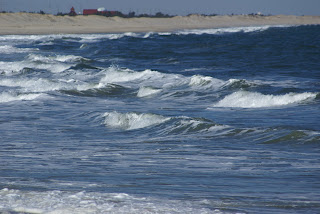

Birding winter beaches has its points. While the number of familiar species is down, no pelicans, terns, or laughing gulls, the beach holds surprises. Razorbills, murres, and loons, birds of the Arctic, sport in the wave troughs, while rafts of snow geese newly arrived from Greenland bob just outside the breakers.

A few familiar birds eke out winter sustenance along the tide line. Herring gulls, some possibly remembering summer handouts, sidle up like hopeful beggars or stand wrapped in their feathers, one baleful eye following you. Sanderlings, birds who spent their summer in the high Arctic, are here all year, running like windup toys along the edge of the sea foam. A circumpolar species, they are probably the best traveled bird on the planet. Sanderlings spread out on winter beaches from Cape Cod to Tierra del Fuego on the Atlantic and from Korea to Australia on the Pacific.

I have been visiting winter beaches all my adult life. I always find something new, something different. A plethora of purple starfish along the top of the lower beach, cast up by last night’s high tide, gone the next day and replaced by an equal number of moon snail shells. Sometimes, purely by chance if you happen to be looking out to sea at the right time, the flukes of a sounding whale, probably a humpback. And once, a young harbor seal, with heart shaped nose and soulful puppy dog eyes, perched on a rock at the jetty. Fins tucked in, dozing in the watery light, waiting for the tide to turn and fish to catch.

Everything—color, shape, lighting—is different. The sand, lacking the sun’s summer heat to bake out the moisture, goes from that neutral beige favored by home decorators to a cold gray. Footprints last days, even weeks in the damp and pockets of frost and sea ice linger in the hollows. This would be a great time to build magnificent sand castles if you could keep any feeling in your fingers. The major change to the winter beach is the cold. A damp chill that penetrates the marrow of your bones, combined with the constant wind straight from the Pole, stings then numbs any exposed skin. You are at the lowest part of the continent and the cold runs downhill like water. Bundle up.

Thin winter light and sharp shadows give a painterly cast to the landscape, while the sea itself is a deeper, darker color. Waves, depending on the recent weather, either hiss up the slope in slides of foam and ice, or drop all at once like a collapsing wall. Surfers are few and far between. The beach shape turns from a long easy glide to the water’s edge into a double slope with a three-foot berm separating the upper beach from the lower. Skeletons of shipwrecks, keel and ribs poke out the sand on the upper beach. When the wind is right and nobody else is about to distract you, snatches of voices, just below hearing threshold, go through your brain. Old beach combers say certain beaches are haunted; maybe so.


Birding winter beaches has its points. While the number of familiar species is down, no pelicans, terns, or laughing gulls, the beach holds surprises. Razorbills, murres, and loons, birds of the Arctic, sport in the wave troughs, while rafts of snow geese newly arrived from Greenland bob just outside the breakers.

A few familiar birds eke out winter sustenance along the tide line. Herring gulls, some possibly remembering summer handouts, sidle up like hopeful beggars or stand wrapped in their feathers, one baleful eye following you. Sanderlings, birds who spent their summer in the high Arctic, are here all year, running like windup toys along the edge of the sea foam. A circumpolar species, they are probably the best traveled bird on the planet. Sanderlings spread out on winter beaches from Cape Cod to Tierra del Fuego on the Atlantic and from Korea to Australia on the Pacific.

I have been visiting winter beaches all my adult life. I always find something new, something different. A plethora of purple starfish along the top of the lower beach, cast up by last night’s high tide, gone the next day and replaced by an equal number of moon snail shells. Sometimes, purely by chance if you happen to be looking out to sea at the right time, the flukes of a sounding whale, probably a humpback. And once, a young harbor seal, with heart shaped nose and soulful puppy dog eyes, perched on a rock at the jetty. Fins tucked in, dozing in the watery light, waiting for the tide to turn and fish to catch.

Saturday, December 27, 2008
Guilty Pleasures
Last night, Pat and Ariel sat me down to watch the DVD of Mamma Mia. This movie could just as well be titled Chick Flick for all of the singing, dancing, and utterly outrageous story, all tenuously held together by the music of ABBA. It is a remake of Buona Sera, Mrs. Campbell, a 1968 tearjerker starring Gina Lollobrigida. Mamma Mia has a star-studded cast, great actors all, but unfortunately, not a singer amongst them. The sole exception is Christine Baranski, a veteran Broadway actress, who knows how to play to the balcony.
ABBA, as we all know, was a Swedish pop group who blended disco and pop to produce total schlock. Schlock sells and for a time, ABBA was the number one money-maker from Sweden, bringing in more money than Volvo.
Lord help me, I actually enjoyed the film. I don’t know if it was Meryl Streep singing her way through “Dancing Queen”, or the guy who played the dead pirate with barnacles on his face in Pirates of the Caribbean, or Colin Firth playing a totally befuddled second male lead (“where am I? and what is this terrible movie I’m in?”). Actually the best part was listening to Pierce Brosnan (“Bond, James Bond”) singing. At last, I have found someone who has a worse voice than I do! He not only misses the key, he misses the door, the building, and the whole damn zip code.
When the three males leads come on for the final big production number, it is worth sitting through the first couple of days of the film. No human male should have to wear what they had on. They forfeit all of their guy rights for the next 10 years for that one.
I guess I have company, Mamma Mia is the highest grossing movie musical in history. The National Movie Awards gave it Best Musical, with Streep winning Best Actress and Brosnan getting a nomination for Best Actor. The Golden Globes nominated it for Best Picture, and Best Actress. There is even talk of a sequel, apparently there are a lot of unused ABBA songs left to go.
I think I’ll skip the sequel, but at least I know I can sing better than James Bond.
ABBA, as we all know, was a Swedish pop group who blended disco and pop to produce total schlock. Schlock sells and for a time, ABBA was the number one money-maker from Sweden, bringing in more money than Volvo.
Lord help me, I actually enjoyed the film. I don’t know if it was Meryl Streep singing her way through “Dancing Queen”, or the guy who played the dead pirate with barnacles on his face in Pirates of the Caribbean, or Colin Firth playing a totally befuddled second male lead (“where am I? and what is this terrible movie I’m in?”). Actually the best part was listening to Pierce Brosnan (“Bond, James Bond”) singing. At last, I have found someone who has a worse voice than I do! He not only misses the key, he misses the door, the building, and the whole damn zip code.
When the three males leads come on for the final big production number, it is worth sitting through the first couple of days of the film. No human male should have to wear what they had on. They forfeit all of their guy rights for the next 10 years for that one.
I guess I have company, Mamma Mia is the highest grossing movie musical in history. The National Movie Awards gave it Best Musical, with Streep winning Best Actress and Brosnan getting a nomination for Best Actor. The Golden Globes nominated it for Best Picture, and Best Actress. There is even talk of a sequel, apparently there are a lot of unused ABBA songs left to go.
I think I’ll skip the sequel, but at least I know I can sing better than James Bond.
Thursday, December 11, 2008
The Wreaths of Old Town

Last Saturday we went to the Scottish Walk parade in Old Town, Alexandria. The Scottish Walk is an old local tradition, celebrating Alexandria’s Scots heritage. Pipe bands, politicians, Scottish clan societies, and hordes of Scottish dog breeds march over a round-about course for a dozen or so blocks. Our son, Alec, was a drummer for the City of Alexandria Pipes and Drums Band and we have been attending the Walk ever since.

An extra added treat is walking down the quieter streets and looking at the Christmas wreaths on the doors. Some are plain, others beautiful in their intricacy. The wreaths are entries in an informal contest, one that has been going on for over 35 years. Organized and judged by the Old Town Walled Garden Club, winners are announced in the Alexandria Gazette Packet newspaper. They receive a small prize (usually a gift certificate to a local restaurant) and bragging rights for the year.


The rules are simple: residents must decorate their own wreaths and use only natural materials (except ribbon), no lights, and no professional florists. Judges drive all 40 miles of Old Town's streets, coming to a consensus by the end of the day.

Door owners in Old Town take the "only natural materials (except ribbon)" rule to extremes. Wreaths run the gamut from plain pine and cedar with ribbon, to flowers, or seed pods, or whole oranges studded with cloves, or anything else from the fruit and vegetable bin.


Some wreaths are made from tropical fruit, complete with pineapples. Pineapples are a colonial symbol of welcome, dating from long sea voyages to the Indies. Upon return, the sea captain would display a pineapple to show he was home and receiving visitors.


There are wreaths made of ribbon, taking the "except ribbon" clause to the edge.

More than one wreath is made with feathers.

Wreaths with artichokes and other assorted veggies,

Wreaths made from tree bark,

One made from pears,

One made from seashells,

And even one made from red potatoes.

I don’t know who will take home the gift certificate, but if these photos are any example, the judges will be hard put to declare a winner. I guess the non-winners eat the tasty parts of their wreath.

Subscribe to:
Posts (Atom)